If there was ever such a thing as ‘lounge rock’, Louis Prima would be its inventor and chief purveyor. His performances with Keely Smith, Sam Butera and The Witnesses in Las Vegas in 1950 emptied the gambling halls and showed it wasn’t just the kids digging the big beat…
In 1982, the British rock’n’roll revival band The Stargazers laid down a version of one of Louis Prima’s greatest shuffles Oh Marie. Although supported by a stylishly shot video by Absolute Beginners director Julian Temple, they were dismayed when CBS put it out as Hey Marie for their second single. Possibly the band were right, because Hey Marie didn’t chart.
But it was a fine piece of work, Danny Brittain delivering a Prima-esque vocal without sounding like a carbon copy, and the Anders Janes (double bass) and Ricky Lee Brawn (drums) rhythm section on top form. Three years before David Lee Roth of Van Halen launched a solo career with an excavation of Prima’s Just A Gigolo / I Ain’t Got Nobody in 1985, which was widely seen as sparking a revival of interest in Prima’s music, The Stargazers had already done it for more selective British rock’n’roll fans.
Sicilian Showman
Technically speaking, Louis Prima was no rocker. Born in New Orleans in 1910 and of Sicilian stock, he was a product of the Jazz Age, a fine trumpeter in the Louis Armstrong style, an unusual vocalist – and a great showman. The rockin’ sides he made in the 1950s were stumbled on almost by accident when going through lean times early in the decade.
Even when he was rocking, he never lost the Dixieland jazz and big band swing phrasings of his earlier years in the Crescent City and New York. In his 1930s heyday, his wiggling hips had women swooning in the aisles, but 20 years on, though still a surprisingly energetic mover, he cut a middle-aged figure.
But for lovers of the more swingin’, fun-loving, non-angsty side of rock, Prima and his small combo are up there with Bill Haley And His Comets, The Treniers and Freddie Bell And The Bellboys. While his 50s revival came at a time when many Italian-American crooners were flying high, Prima had a gravelly voiced edge about him, and his interplay with singing foils Keely Smith and Sam Butera were pretty near the knuckle for the slightly older audiences that came to watch their shows.
He was the Wildman Of Las Vegas, one of the all-time great crowd-pleasers. Eventually, he fell out of fashion in the 60s. But Prima’s music is so infectious it won’t lie down.
King Of The Swingers
His last big track, I Wan’na Be Like You (The Monkey Song) from Walt Disney’s The Jungle Book in 1967, introduced his voice to a whole new audience. Aside from The Stargazers and David Lee Roth, the likes of Ray Gelato, Big Sandy and The Jive Aces have all drawn inspiration from the great man. Brian Setzer has also paid tribute to him, including a song, Hey, Louis Prima, on his Guitar Slinger album in 1996.
It was in a tiny room in the Sahara Hotel on the Las Vegas Strip where Prima’s rockin’ reincarnation took place. The Casbar Lounge had “a low ceiling, poor ventilation, one spotlight, one microphone, and an upright piano – there wasn’t room for a baby grand,” as Keely Smith recalled for Vanity Fair in 1999. “And there was a service bar right in front of us!”
Prima and Smith started off with five shows in the graveyard slot beginning at midnight, quite a comedown for the man whose Sing, Sing, Sing was a jazz standard and who’d once been the toast of Swing Street. But Prima had always known how to make a splash, so perhaps it was no surprise that he turned his fortunes round quickly.
Jump Jive An’ Wail
When Prima left New Orleans to try his luck in New York in 1934, it was his showman-like and comedic capacities as much as his abilities as a trumpeter that won him attention in a crowded market. When he played the Famous Door with a five-piece combo, he initiated 52nd Street’s transformation into the fabled ‘Swing Street’. Women went wild for the still slender Prima, his slinky moves and exuberance drawing comparisons with Cab Calloway. When he moved to Hollywood, he set up his own club which he also called The Famous Door, where, according to his biographer Garry Boulard, “dressed in white, with his dark curly hair tumbling over his forehead,” he was able to send his audience into a frenzy, “with that strange combination of humour, music, and sexual suggestion.”
Transitioning to the big band sound in the 1940s, he broke attendance records across the United States.
Even so, the Vegas triumph was something else, because the circumstances in which it started seemed so dire. Prima had first recruited Smith to sing in his swing orchestra in 1948. But big bands were on the wane and Prima folded the collective a year later.
By the early 1950s he wasn’t selling many records either. But Smith was an effortlessly fine, natural singer, with perfect pitch, and as the pair, who married in 1953, did dates in small clubs across the States, Prima had the brainwave to build a new set around their stage show, hitching elements of Dixieland jazz, swing and jump blues to the rising new rhythms and back beats of rock’n’roll.
The chemistry between Prima, as the clownish, lecherous older man, and the younger Smith, the epitome of cool, was so good it created an entirely unique dynamic. Time magazine called their banter “doggedly vulgar”, but they were genuinely funny.
Just A Gigolo
A further key ingredient was fellow New Orleans jazzman Sam Butera, also of Sicilian stock. He was brought in to arrange the material, as well contributing some rockin’ interludes of his own. Like Prima, he was a master of jive talk, and could play the honking tenor sax which had become a standard feature of R&B. As with Smith, he was a perfect foil, playing off, but never threatening to overshadow, the extrovert Prima.
Behind them were The Witnesses, all expert jazzers in their own right but instructed by Prima to play for their audiences, rather than for the approval of fellow musicians. It was this desire to please and refuse to go down a jazz rabbit hole that both saw Prima dismissed by the highbrows and adored by those who paid to attend the shows. What had started as an unpromising two-week engagement at the Sahara in November 1954 ended up running until the end of the decade.
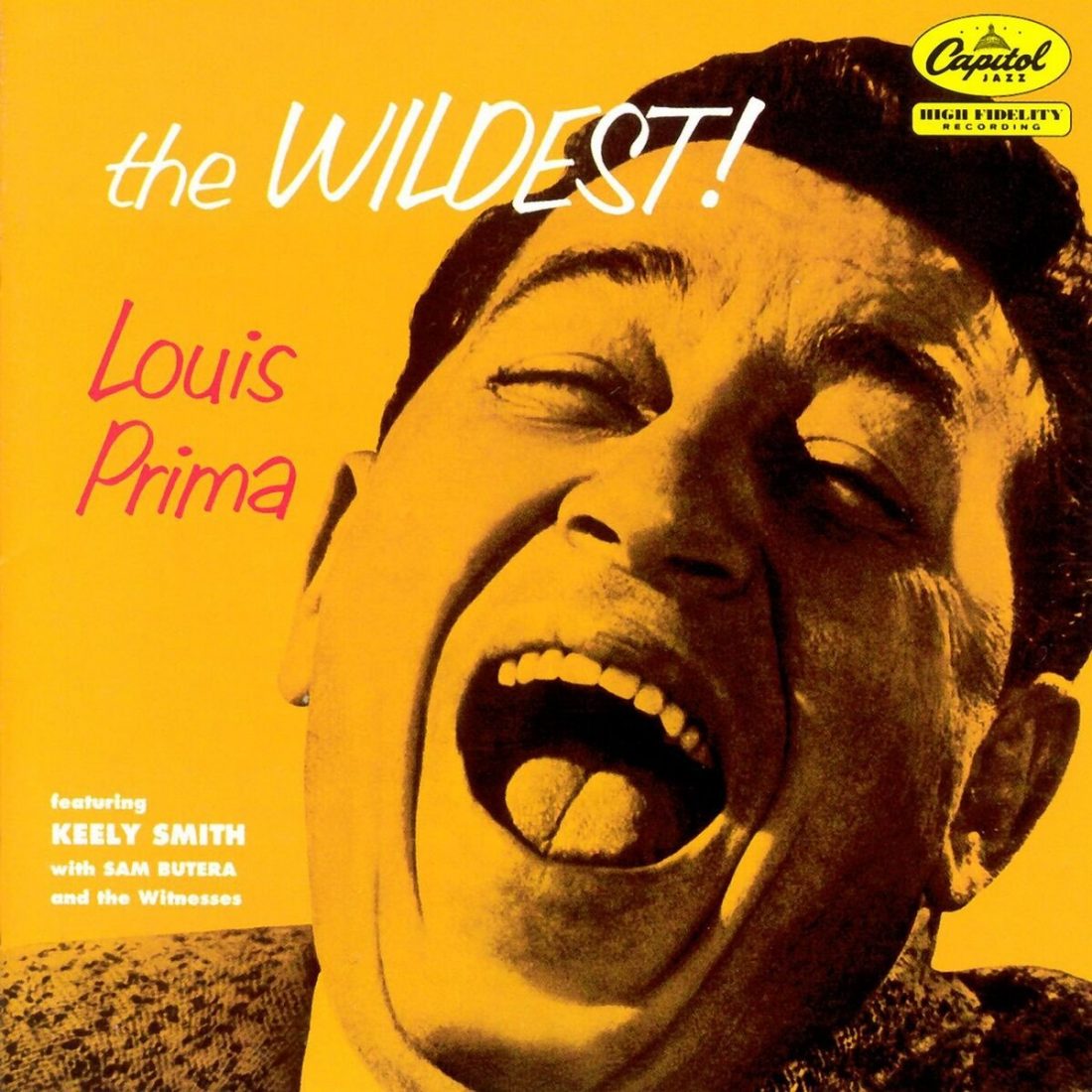
Sadly, no footage survives of these sets, although there are clips of Prima, Smith and Butera guesting on the Ed Sullivan Show. Sullivan said that the only artists who could hike the ratings just by advance billing of their appearances were Prima and Elvis. Fortunately, Prima did make numerous records for Capitol which captured something of the energy of the Sahara sets, including The Wildest!, The Call Of The Wildest and, made in 1962 after Prima had split with Smith, The Wildest Comes Home!.
Scatty Shuffle
A key element of the Prima Vegas sound was the shuffle rhythm, deployed at various tempos. A fast one was the classic Oh Marie, originally a turn of the 20th century Italian ballad. Prima recorded it several times, including with his big band in the 1940s, and a comic one in waltz time for Columbia in 1953. It is the shuffle version which appears on his 1956 Capitol album The Wildest! which is essential listening, however.
It was later released as a single, paired with Buona Sera. The latter is a touch slower, offering an example of the way Prima mixed rhythms. It starts with a slow, teasing tango, Prima roughly crooning like a Neapolitan balladeer. He’s briefly joined by Smith leading the backing vocals before a Prima scat signals the move into another infectious shuffle.
A loping introduction kicks off Just A Gigolo/I Ain’t Got Nobody. A top example of the way Prima and his combo could build irresistible, swingin’ momentum, it is one of his greatest. Jump Jive an’ Wail showcased the call and response dynamic between Butera’s raging sax and Prima’s trumpet. When You’re Smiling/The Sheik Of Araby, its looseness concealing the immense amount of rehearsing they put into their material, allowed Butera’s sax to really cut loose.
The Wildest Wildman!
That Old Black Magic was a spellbinding reworking of a standard, the chemistry between Prima and Smith never clearer. More obviously shaped for the young rockin’ market were Beep! Beep! recorded to mark the launch of the first Sputnik satellite in 1957, and singles released in Butera’s name, like Ten Little Women, Equator and Love Charm.
Sadly, Prima and Smith divorced in 1961. Although they both continued to record great music, the peculiar charm of their desert music was lost. But Prima was the bridge between swing, jump blues and rock’n’roll – not just the wildest, but at his best, the greatest.
For more on Louis Prima click here
Subscribe to Vintage Rock here