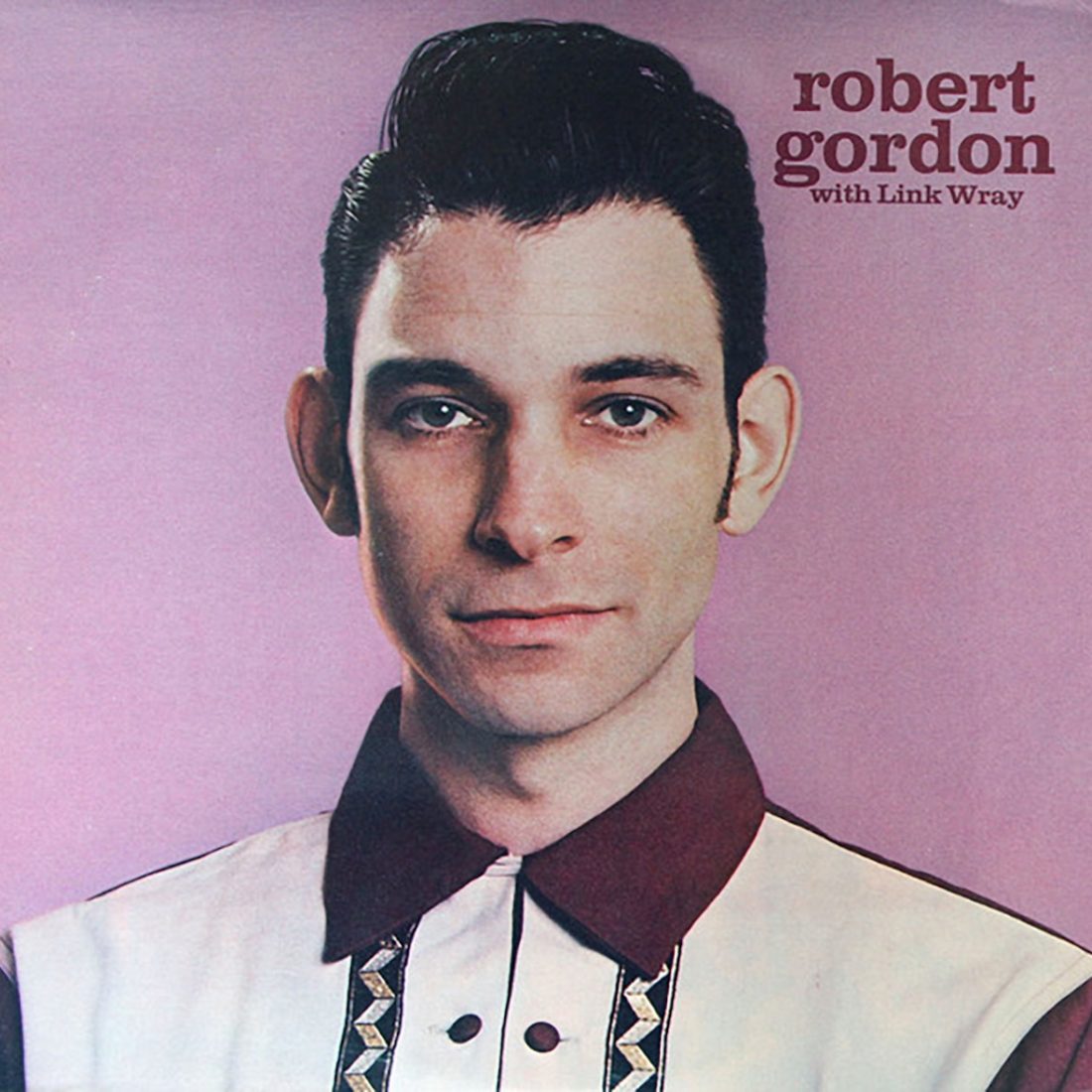
After punk beginnings in amongst New York’s elite he led the way for the rockabilly revival in the States with the help of one of the golden era’s most unique and rebellious guitarists. Vintage Rock remembers a late-70s masterstroke – Robert Gordon & Link Wray.
He was first to throw a punch in the rockabilly revival in the USA; Billboard magazine dubbed him “the new voice of rock’n’roll”; and quite frankly, Robert Gordon should have been a superstar – were it not for unfortunate timing.
With his razor-sharp greaser looks and a sartorial elegance unmatched since Elvis first swaggered in from Memphis, Gordon was one uber-cool customer. Add in a genuine 50s icon and the ultimate rebel rouser, Link Wray, whose career was given a new lease of life thanks to his association with Gordon, and the results were always going to be something special. Robert Gordon With Link Wray was their first instalment, spearheading the upsurge and clearing the way for the likes of the Stray Cats, Reverend Horton Heat and Kim Lenz to take America’s rockin’ music into the mainstream in the video era.
And, while we’re all now well versed on the rise of rockabilly music from the 70s and on, Gordon was at the frontline. “There was no rockabilly revival when I broke through,” he told Guitar Player in 2021. “There were people here and there playing it, and it was always popular in the UK and Europe, but it tended to be older guys, whereas I was a lot younger and had a real strong image. The Stray Cats really benefitted from the MTV age, although I think I did kick off the rockabilly revival in the US.”
Red Hot Revival
In the 1960s, Gordon had cut his teeth playing school dances and teen clubs as part of The Confidentials, and then fraternity parties, night clubs and even a Greyhound bus station with The Newports. Entering the New York punk scene with No Wave outfit Tuff Darts in the mid-70s, Gordon became a regular face at CBGB, hanging out with the greats of that scene: Television, Blondie, Ramones and Richard Hell.
Tracks like I’d Rather Slash My Wrists And Cut My Throat (Than Spend The Night With You) give a hint as to Tuff Darts’ character, one that Gordon told the It’s Only Rock And Roll podcast in 2020 was “pretty sadistic” with lyrics that were “pretty chauvinistic”. He further clarified this early misstep to Peter Silverton of Sounds in 1978: “That was only a brief period. I really didn’t dig the music. All it was really was like an introduction to the scene. I was in a negative, hostile frame of mind at the time and that was a good outlet. And that’s all I’m gonna say about it.”
Yet, in a positive light, Tuff Darts and his association with CBGB gave Gordon a modern edge and, vitally, was his route into meeting producer Richard Gottehrer and his eventual deal with Private Stock.
Bringing It All Back Home
Gordon was thrilled to be returning to the music of his teenage idols – Elvis, Gene Vincent, Eddie Cochran, Jack Scott, Buddy Holly, Wanda Jackson and Hank Williams – and notably long before the reign of music television, that helped the later revivalists steal his thunder. In fact, when Gordon arrived, rockabilly was far from the “in” thing; reviews of the time – “Gordon is a weird little guy with a big Elvis voice,” wrote Robert Duncan in Creem – show that many scribes just didn’t know what to make of him. And yet, while ahead of his time, Robert was having the time of his life. “It was exciting, man!” he later beamed to Harpmagazine’s Fred Mills. “We were doing something nobody was doing. It was like really bringing back a whole new kind of music – it caused a lot of excitement back then, too.”
And rock’n’roll seemed a far more natural territory for the young hopeful, reinvented as a pompadoured hep cat (Gordon “looks like he fell asleep in 1958 and only just woke up,” joked John Tobler in Zag Zag at the time), and it was that authenticity, recognised from his own era, that first drew a legend such as Wray his way.
“Elvis started this whole thing,” Link told WHFS’s Thomas Grooms at the time of the album’s release. “As long as I’m on the stage, they gonna remember Elvis. And as long as Robert Gordon’s on the stage, they gonna remember Elvis, because that’s what got me with Robert Gordon, ’cause I thought Robert Gordon sounded like Elvis when he was on Sun, you know the early Elvis. And when I heard Robert sing… I said ‘Yeh, that’s gotta win’. I’m from the South and Presley’s from the South and Robert’s from Bethesda, but still he’s got that Southern feel – and I dig that!”
Royal Rumble
Aside from both reframing the formula for their respective generations, Elvis and Gordon shared other vital similarities that stood them out. Not only was it Heartbreak Hotel that first turned Robert’s head to rockabilly as a nine-year-old kid with a wireless held up to his ear, but, much like his hero’s youth spent soaking in the sounds of Beale Street in Memphis, Robert’s musical education also came frequenting venues mostly filled with Black teenagers.
“When I got to my mid- to late- teens, we used to go to the Howard Theater which was like the Apollo in New York,” he recalled to the It’s Only Rock And Roll Podcast in 2020. “We saw the great Motown acts of that period. It was really amazing… and I must say I was one of the only white people in the place, but I didn’t care man, it was just so fuckin’ cool.” Not only that, but Gordon would end up on his hero’s label, RCA, who bought out his contract for third album Rock Billy Boogie, just as they had bought Elvis’ Sun contract back in late 1955 – and that was something Gordon was hugely proud to point out.
For his first foray into rock’n’roll, when paired with the masterful, rebel guitar-slinging Link Wray, Gordon was perfectly poised to bring “a harder edge” to his beloved rock’n’roll, recasting it for the late 70s. Link after all, still holds the distinction of being the only artist that’s had an instrumental banned from the airwaves – Rumble, is of course the culprit, raw violence permeating its mighty grooves. Kindred spirits of different eras, one need only look at the back sleeve of Robert Gordon With Link Wray to see how perfectly the two fit together, the ultimate double billing: a young, bequiffed Gordon exuding confidence in his plain white vest, Wray brooding and mildly intimidating in shades and dressed all in black.
Rebel Rocker
Gordon had first been “blown away” by Wray as a kid at Glen Echo amusement park in Maryland when Rumble first came out, so the match-up was surely a dream for Robert. “I’m very proud of the fact that I wanted to put his name on the album cover,” Gordon told Guitar Player. “That was my decision, because I wanted him to get the recognition he deserved, and then he went on to have a second coming, I guess you could say.”
The two first came together professionally via mutual friend Gottehrer, producer of his fellow CBGB stars Blondie and Richard Hell, who invited Wray to New York. With Wray sent a plane ticket from San Francisco to New York, the two hit it off instantly.
Signed to Private Stock, Blondie’s early stable, Gordon and Wray assembled a band via auditions, remembered by the album’s rhythm guitarist Charlie Messing on furious.com. “Robert arrived, dapper and confident. He had a 1950s haircut which enjoyed frequent combing. He was serious about becoming a star. He came in, took out some charts and lists, gave a few tips to the sound man, and soon we were playing rockabilly. He was a real good singer.”
Heavy-Duty Reverb
Having culled the deadweight with the help of Gottehrer, “the Wildcats” were finally assembled: New York hired guns, ex-Rolling Thunder members Howie Wyeth (drums) and Rob Stoner (bass, piano) – “a punchy and concise rhythm section,” wrote Trouser Press – and their friend Billy Cross (guitar) joined Messing, before Wray’s timely arrival in the studio. “[Wray] was a little skinny guy with an elaborate hairstyle and dark sunglasses,” recalled Messing. “He had the most amazing way of playing – he’d been a rock and roll pioneer for 20 years by then. And he played deafeningly loud.”
With rehearsals complete, recording began at New York’s Plaza Sound Studios at the top of Radio City Music Hall in a large room with a high-vaulted ceiling, and with the Wildcats’ new six-stringers – Messing’s rhythm parts laid down using a Gibson SG and Billy often doubling them on a Fender – making sure ample room was available for Wray’s all-important, ear-bleeding lead. “Link played through a big old Gibson amp about the size of a Fender Super Reverb,” remembered Messing of Wray’s mammoth rig.
“He’d replaced the speakers with heavy-duty ones that weighed 60lb each, so the amp was almost impossible to move. He set it with all the knobs on ten, and just used the guitar controls while playing. It was loud, yes indeedy. We were all in awe. We had heard him when we were still kids. He was a talented show-off, and this was a good gig for him because it was a chance for an old star to shine. Robert was, hopefully, the new star.”
Golden Era Classics
The songs were a mix of golden era classics and Wray originals, with choice cuts from Sun legend Billy Lee Riley, Carl Perkins, Eddie Cochran and Gene Vincent, as well as Bob Feldman – writer of The Big Beat theme to Alan Freed’s TV show, as well as Lee Hazlewood, who’d worked with Duane Eddy in the late 50s, co-writing Rebel Rouser. And while respectful of those hallowed originals, this was no rerun, as Gordon made very clear to John Broughton on the Retrospectives radio programme in 2021: “We never tried to recreate that sound, there are bands now that of course try to recreate it exactly like the old school but I took it to a different place with a harder edge to it, which is why I considered working with Link, who was a heavy player.”
To that end, first up was Riley And The Little Green Men’s classic single Red Hot, the album’s only minor hit (Billboard No.83) and, in search of another big song for the record, the last to be laid down in the studio. It’s a fiery, relatively faithful recasting, albeit with the tempo raised a touch, employing a snappier snare, handclaps lower in the mix, and Gordon’s brighter, rock-solid vocal tearing up the studio. Here, Link takes Roland Janes’ original deft-fingered lead and ramps it up a notch, while Jimmy Wilson’s pounding piano, played on the duller 1949 Wurlitzer spinet upright at Sun, is replaced by an 88-busting, soaring remake from Rob Stoner.
“Bop, Cat, Bop!”
Eddie Bryan and DJ Sheriff Tex Davis’ love ballad I Sure Miss You, cut by Gene Vincent And His Blue Caps in 1957 for Capitol, slows things down, Gordon’s Presley-esque baritone a silky, yet passionate weapon. Link’s guitar follows Cliff Gallup’s winding, tremolo‑picking Gretsch Duo-Jet closely.
Brave is the man who takes on Cochran’s infamous Summertime Blues, and yet Gordon and Link manage superbly with their diamond-clear reimagining, a slightly bolder feel with brighter clarity marrying well with Gordon’s hiccupping take.
Carl Perkins’ shuffling mainstay Boppin’ The Blues follows, this time Gordon and band tighten up the sails for a roomy, vibeful take, importantly an electric bass taking the lead and altering the feel completely, with a snappy snare drum in support. Link’s guitar joins the foray a little later than on Perkins’ original and to great effect, injecting a fresh dynamic to Carl’s part, cutting through the band and with added flourishes. Introduced by Gordon’s drawling “Get it cat!”, just as Perkins had shouted on the original, Wray’s solo treads similar ground to Perkin’s but with characteristic reverb and a sharper tone bringing it into the 20th century. Dropping to creeping bass and drums late on is a clever move, adding weight to its closing bars, crashing to a close after that familiar cry of “Bop, cat, bop!”
Let’s Rrrrrrroooock!
Having co-written the mid-60s hits My Boyfriend’s Back for the Angels and The Strangeloves’ classic I Want Candy, Gotteherer and Bob Feldman’s Presley-esque Sweet Surrender seemed a natural fit. A straight-up, yearning love lament, as Gordon purrs “Do you remember the night we spent together/ You came to me in sweet surrender,” it’s a dewy-eyed, starlit affair thanks to a stirring vocal and some fluttering motifs from Link.
“I don’t believe in the word nostalgia.” Gordon told Grooms in ’77, and nostalgia is most certainly out of the window with the second hallowed Billy Lee Riley tune that opens Side Two. It’s an album highlight, with Wray’s ample guitar skills lighting up Flyin’ Saucers Rock & Roll, and adding some filthy fuzz to Janes’ tremulous fretting, laid down back at 706 Union Avenue back in late-’56. The whole band are right in the pocket, and the groove fires up with a newfound vigour, again with a rolling electric bass replacing Marvin Monroe Peppers’ thudding upright. The garbled screams of the original are gone, replaced by a powerful chorus of “Rrrrrrroooock!” Anyone that’s wondering how to update rockabilly without destroying its heart, this is how you do it.
Rock Billy Boogie
Gordon and Wray’s tidy version of Lee Hazlewood’s The Fool, a simmering hit for Sanford Clark back in 1956 and also recorded by Johnny Kidd & The Pirates, Johnny Burnette and Elvis, is a wondrous reimagining, with Stoner’s bass and Wray’s dirtier blues guitar sparring beautifully throughout.
The album closes with three Wray compositions. The first, It’s In The Bottle, features another fine baritone delivery from Gordon, emoting of lost love over an interwoven blend of picked acoustic and a steel-esque electric guitar, a country-leaning feel that augments those mournful lyrics with aplomb. With a splash of Johnny Cash, Gordon operates right at the bottom of his register for Woman (You’re My Woman), allowing a nice dynamic to the uplift of the chorus. Wray, meanwhile, delivers a scratchy solo over some crashing interplay from the rhythm section. Is This The Way closes out the LP, a piano-driven country weeper with Wray’s reverb-heavy solo piercing through the mire. It draws the curtains in stirring crescendo.
Crazy Man Crazy
Despite those scratched heads, reviews were mostly good. “Gordon is the best rockabilly singer I’ve heard since the 50s,” beamed Zig Zag’s Tobler, “Robert Gordon may be the first 70s artist to come close to the excitement of his original idols.” John Young, writing in Trouser Press, meanwhile, found an LP “raw and unrestrained, just like the earliest days of rock’n’roll.” Elsewhere, Chas De Whalley at Sounds added, “Link Wray and the band actually sound as physically exciting now as rockabilly must have done when it was fresh, new and rebellious 20 years ago.”
While given a fresh boost later on, Robert Gordon With Link Wray had little impact on its release beyond Red Hot’s presence in the lower echelons of the Billboard. And while Gordon would go on to record with some modern guitar greats, despite a Billboard No.76 placing with Are You Gonna Be The One in 1981, Gordon’s fire – commercially at least – would sputter out.
Later LPs would shift more units and a second album assembled from the sessions with Wray, Fresh Fish Special, is essential listening, especially as it features Elvis’s chosen vocal group The Jordanaires and Bruce Springsteen, who played keys on a cover of his track, Fire. But Robert Gordon With Link Wray is the more important record in rock’n’roll history. Out of time, yes, but a knockout punch nonetheless.
Listen here
Subscribe to Vintage Rock here