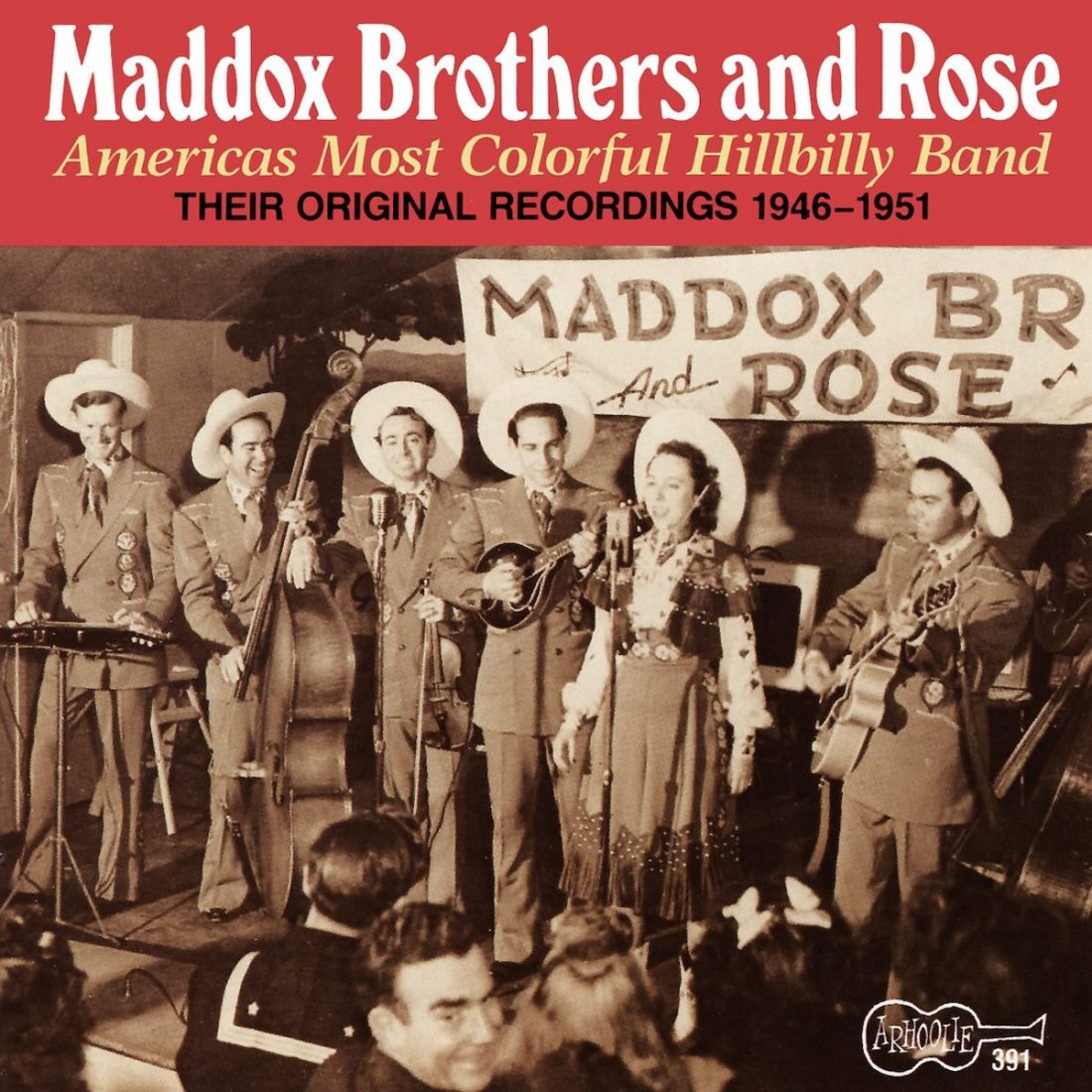
Bringing style and panache to hillbilly music, the Maddox Brothers And Rose’s rock-a-boogies have seldom been surpassed for riotous spontaneity…
Country stars whose music anticipated early rock’n’roll continue to be under-sung. No one tires of citing the inspirational work of Louis Jordan, Joe Turner, Howlin’ Wolf and Elmore James. So what about Tennessee Ernie Ford, Moon Mullican, Lloyd “Cowboy” Copas, The Carlisles and Bob Wills And The Texas Playboys? Above all, what about the Maddox Brothers And Rose? Years before Bill Haley swept into the American and British charts with Rock-A-Beatin’ Boogie in 1955, this riotous hillbilly ensemble were knocking out some of the most life-affirming rock-a-boogies of all time. George’s Playhouse Boogie, Mean And Wicked Boogie, Water Baby Boogie and New Step It Up And Go were rockabilly in all but name.
They never scored any national hits, but in their 1940s and early 1950s pomp anyone in the southern states wanting to see a show that was a little more “out there” than your average country turn knew they were the ones to catch. They were earthy but flamboyant, funny yet musical. They clowned around like vaudeville entertainers, but the tunes were good. Saucy numbers like Sally Let Your Bangs Hang Down were interspersed with straight country like the beautifully harmonised Dark As The Dungeon and Gosh, I Miss You All The Time, and touching ballads like I’m Sending Daffydills or No One Is Sweeter Than You, all delivered as if butter wouldn’t have melted in their mouths.
“America’s Most Colourful Hillbilly Band”
Although they sent up their hillbilly roots, they were almost unparalleled in their sense of performance, and it extended beyond the show itself. Ahead of a date, they’d roll into town in big, swanky Cadillacs, driving up and down the streets to make sure the locals knew they’d arrived. They looked incredible, kitted out in North Hollywood tailor Nathan Turk’s western costumes, embroidered with ornate vine, flower and cactus patterns. When they appeared on the Grand Ole Opry in 1949, rustic comedy regular Rod Brasfield quipped, “Ain’t they the dressed-uppest bunch of folks you even seen? Look at them grapes on them britches.” Their moniker, “America’s Most Colourful Hillbilly Band”, was well earned.
They were highly mobile on stage, and though only one flickering, seconds-long clip seems to have survived for posterity, recordings for the 4 Star label from 1946 to 1951 capture their thrilling spontaneity. For cackling irreverence and cheekiness their music has seldom been bettered. “We just did what we felt and what came natural,” Rose Maddox told Jonny Whiteside for his biography Ramblin’ Rose: The Life And Career Of Rose Maddox (1997). “None of us read music. We were not accomplished musicians.”
Despite that, they were highly musical. Oldest brother Fred slapped a wild bass, sang with a low growl, and offered lewd asides when young sister Rose stepped up to the mic. Cal Maddox played rhythm guitar and harmonica, while emitting bashful girl-like giggles – or sometimes sheep or mule sounds – at suggestive moments in a song. Cliff, who died in 1949, and then Henry, the youngest brother, or “friendly Henry the working girl’s friend” as Fred dubbed him, transformed the tinkling mandolin into an instrument of electrifying aggression and speed. Don, “the wild fiddler,” outlived them all, only passing in 2021, aged 98.
Outside recruits, such as Bud Duncan (steel guitar) and, successively, Jimmy Winkle, Roy Nichols and Gene Breeden as lead guitarists, added further proficiency. Even Glen Glenn had a spell in the band.
Rockin’ Rose
Special attention was paid to Rose with her brazen, high-kicking persona and belting singing style. Hank Williams is quoted in the Whiteside biography as once saying, “When she sings those sacred songs like… Gathering Flowers she sounds just like an angel. Then she’ll turn around and do that song of mine Honky Tonkin’ and she’ll sound like a gal that’s straight out of the cat house.”
Like Wanda Jackson, she shocked the Grand Ole Opry in 1956 when she stepped onstage in a cowgirl suit with a bare midriff to sing her libidinous new song Tall Man. Jackson was already smitten. In an interview for No Depression in 2003, she recalled seeing the Maddoxes play an Oklahoma dancehall before she hit her teenage years and being especially struck by Rose. “She was so feisty, so full of spunk, and they wore all those colourful, sparkly clothes. I said, ‘I gotta be like her.’” Many years later, Johnny Cash supplied comments for the short closing track on Rose’s last solo LP $35 And A Dream (1994), hailing her as “the most fascinating, exciting performer that I’d ever seen in my life.”
That said, Rose Maddox never sounded like the voice of young America. There is something relishable and defiantly undignified about her mature woman’s take on Ruth Brown’s Wild Wild Young Men, for Columbia in 1955. Hey Little Dreamboat and Looky There Over There have a similar older female’s raunchiness.
In her mid-twenties she’d delivered songs like I Wish I Was A Single Girl Again and It’s Only Human Nature with an infectious southern twang, tongue saucily in her cheek. None of the younger teen queens could have pulled these songs off in the same way. Then again, her tough cowgirl persona was wasted on trite rockin’ fare like My Little Baby. She sounded like someone from the frontier era, definitely old enough to be Jackson’s or Lorrie Collins’ mother. Which was fair enough, given the family back story does read like a cross between John Steinbeck’s dust bowl classic The Grapes Of Wrath and The Beverly Hillbillies.
Huge Draw
Originating from the hills of Boaz, Alabama, the Maddoxes were dirt poor sharecropping farmers, but in 1933, dreaming of a better life in California, their formidable mama, Lulu Maddox, got them to pack their bags and join her on the journey out west. Predating the great Okie migration by a couple of years, incredibly they intended to do the 2,000-mile journey on foot or by hitchhiking. Rose was only eight years old.
It took five days just to reach the Alabama state line. With six more states still to cross, including the huge ones of Texas, New Mexico and Arizona, they were fortunate to run into someone who taught them the hobo’s art of leaping aboard freight trains, and praying for a sympathetic brakeman. But when they finally arrived on the outskirts of Los Angeles, the only work they could find was as fruit tramps following harvest trails from farm to farm. They were as poor as they’d been back in Alabama.
Always with instruments to hand, however, somehow Fred blagged them a spot on a local radio station in 1937, and they quickly built a following. Given their experiences and their gritty personas, the way they delivered souped-up versions of country and folk songs had a stamp of authenticity. They made their first recordings in 1946, and secured a contract with Bill McCall’s 4 Star label.
Despite McCall’s exploitation, these were their great years, melding country, folk, western swing, blues and boogie. In the dance halls of the South, they were a huge draw. One of their most popular songs, George’s Playhouse Boogie, was based on a rowdy venue in Stockton, California. Their versions of Move It On Over, Honky Tonkin’, Milk Cow Blues and Mule Train still pack a punch today. They even breathed new life into Woody Guthrie’s Philadelphia Lawyer.
Step It Up And Go
In 1952 they signed for Columbia Records, toning down the antics somewhat. There’s a consensus that some of the magic was lost, though there were further classics like Ugly And Slouchy and The Death Of Rock And Roll, an “out of tune” send-up of I’ve Got A Woman. It worked because they knew how to play rockabilly.
Over time unrest built up, with Rose believing she sang better than her brothers played. At one point Columbia had three separate contracts for her: one with her brothers; one as a solo act; and one as a duet act with her sister-in-law Retta. By the time of the family’s last Columbia session together in 1957, Maddox was being ranked in her own right by the country magazine Country Music Jamboree as one of the top female country singers, behind only Kitty Wells, Jean Shepard, Wanda Jackson, Anita Carter and June Carter.
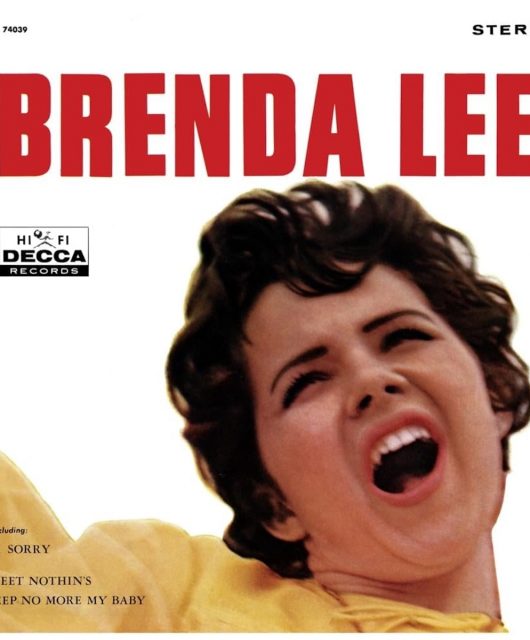
It’s arguable, however, that, in her assertive, feisty style, she was a female trendsetter. And though her keening vocal style and trenchant vibrato sounded dated by the end of the 1950s, she had recorded rockabilly ahead of the likes of Brenda Lee and Wanda Jackson. She was still performing to appreciative audiences both in the States and in Europe until her health gave way in the 1990s.
Listen here
Read More: Classic Album – Wanda Jackson: Rockin’ With Wanda!