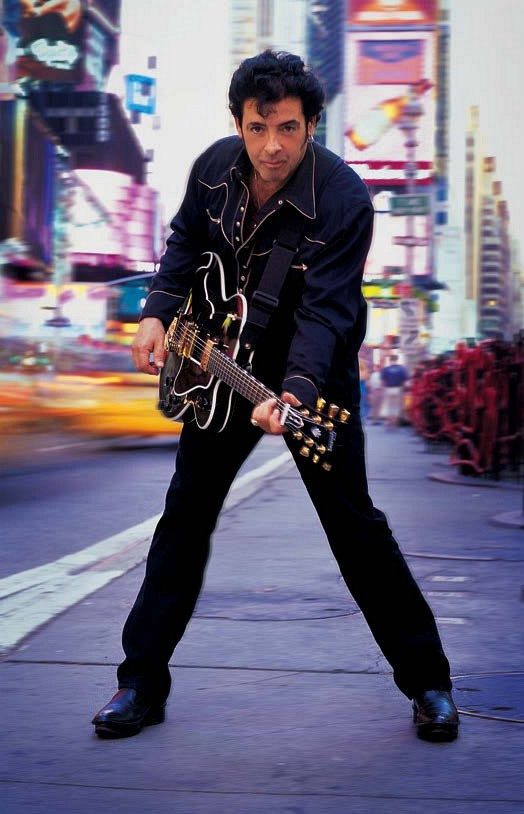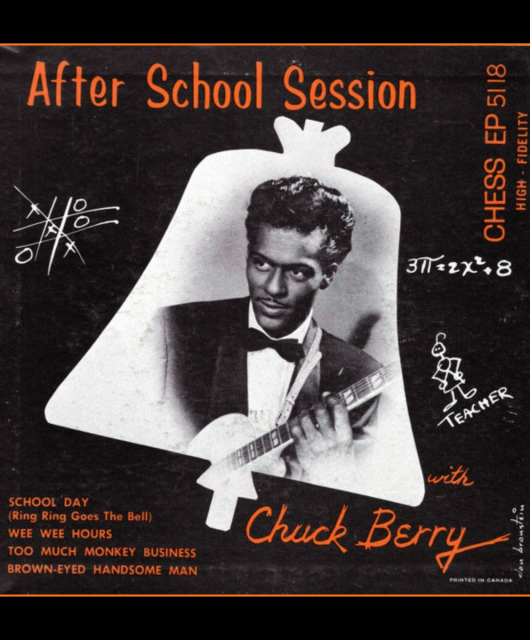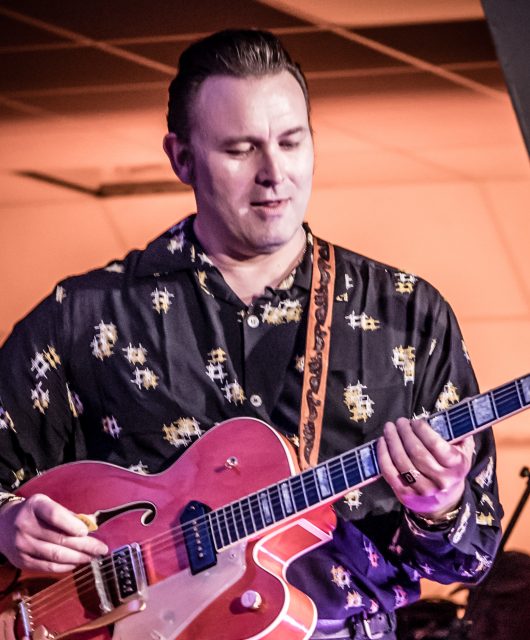
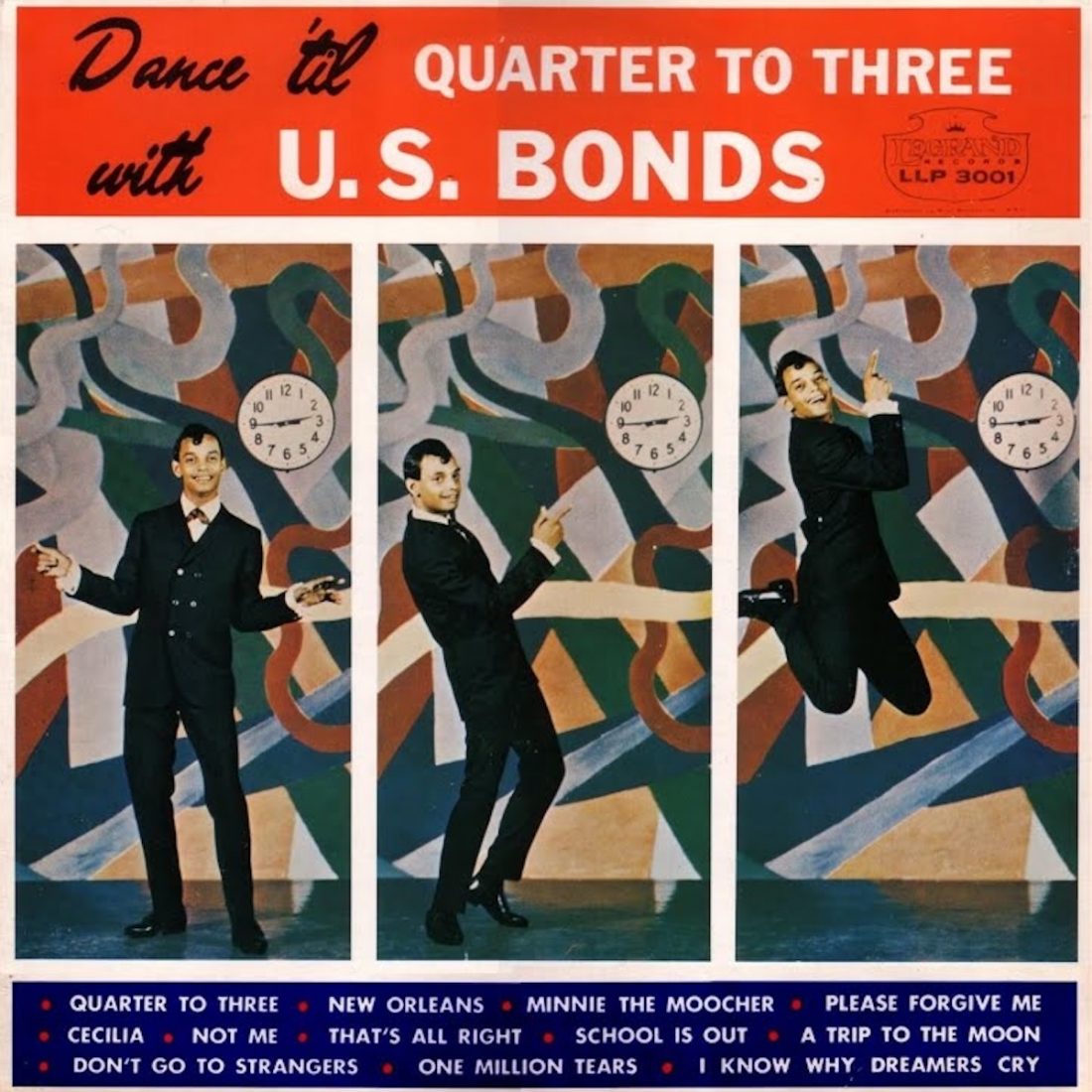
Gary US Bonds hit the big time in 1961, kickstarting a career that spanned over 60 years. In anticipation of a headline UK show in 2018, Vintage Rock talks big hits, awful movies, superfan Bruce Springsteen and more with the legendary performer…
By Bill Dahl
Many of the top rockers of the early 60s were consigned to the oldies circuit by the decade’s end, never again to be serious chart contenders. Not Gary US Bonds, whose thundering New Orleans and Quarter To Three had lit up that pop hit parade like overheated TNT. The incendiary vocalist enjoyed an early 80s comeback every bit as spectacular as his initial run and remains a relevant contemporary artist, playing up to 50 dates a year, and releasing fresh product including his 2009 album Let Them Talk and a 2012 Christmas disc (both issued via his GLA logo).
“I keep listening,” says Bonds, “I don’t get trapped into just following the oldie lead. You get trapped into that and then you get labeled into that. You’re dead meat from there.” To that end, Bonds and legendary tenor sax player Gene ‘Daddy G’ Barge – who graced all of Gary’s early hits except New Orleans – teamed with Chuck D of Public Enemy in 2016 to radically update Quarter To Three as a rap number. “I saw Chuck D at a function somewhere, and he goes: ‘Man, you ever do Quarter To Three again? That’s what I want to do!’” remembers Bonds. “He waited a few years later, but he did. He called me up, and called Daddy ‘G’: ‘Let’s go in and do it right quick!’ I said: ‘All right!’”
Sunshine Star
Born in Jacksonville, Florida, Gary Anderson moved to Norfolk, Virginia as a toddler and started singing there as a teenager. “You tried to emulate all the guys that you see on American Bandstand, or at the local state theatre whenever they came into town, or on the radio,” he says. “I definitely wanted to be Clyde McPhatter, or a Drifter, or a Turban – Clyde was the guy I tried to emulate most.
“I had a group called the Turks. We never really worked anywhere, except on the corner. But we did a couple of talent shows, and we came in second each time. Couldn’t come in first – they had a group there called The Humdingers who were really good.” Gary also worked with Sleepy King. “He used to do a lot of Chuck Willis-type music, because Sleepy wore a turban. He needed another singer, so he hired me and I’d go with him.
“He was one of the first bands that I sang with there: what we called ‘going on the road’. We’d leave Norfolk and go to Scotland Lake, North Carolina. An hour trip, two hour trip… something like that; working in one of those pigfoot joints down in the bottom there.”
Far wilder was the duo Gary formed with James McCleese (eventually finding stardom himself as Jimmy Soul). Back then, they answered to different monikers.
“We were ‘Nature Boy’ and ‘Wonder Boy.’ We used to do a duet together down in Norfolk in loincloths! We used to work at this shotgun club, called Azalea Gardens, and it was a long bar. He would swing in on one end and I’d swing in on the other end, on top of the bar, and we’d meet in the middle and start singing! It was fun. It was weird!”
Grand Schemes
Former New York calypso singer Frank Guida operated a vinyl emporium, Frankie’s Birdland, in Norfolk (“The only record store in the black neighbourhood where we could go and buy records,” says Bonds). Guida dreamed of being a record company mogul, launching his Legrand label in 1959 and establishing a studio soon after that. “He bought this cheap recording machine, he had a bunch of cheap mics, and he put up some egg crates for sound in this room that he bought,” says Bonds.
Guida didn’t search far for a studio engineer. “Joe Royster worked at Florsheim’s shoe department, across the street from the record store,” adds Gary. “He and Frank became friends, so Frank made him the engineer.
“Guida had asked me about a year, a year-and-a-half before, if I would record when he started up his label and his studio.” Bonds continues. “He used to pass by the little corner that we sang on. He’d stop and listen for a while and say: ‘Hey, you guys sound pretty good!’”
Whether by design or thanks to the limitations of their equipment, the overmodulated sound Guida and Royster wrung from their primitive setup was unique. “It was the only sound we had,” says Bonds, whose boisterous delivery of the rousing New Orleans gave him a 1960 smash his very first time out.
Blowing Up A Storm
“Joe Royster wrote the song. It was a country song – I mean, a real country song. And Joe said: ‘You gotta make it R&B or pop or something, because I can’t do this country thing like this.’ So I just changed it around,” explains Bonds. “Like the ‘Hey hey’ part: my mom used to like Cab Calloway, and I remembered that when I saw Cab Calloway with her, the crowd would repeat what he said. So I said: ‘Let me get something like that,’ and I put in a ‘Hey hey hey hey yeah!’ And that was copying Cab Calloway.” Emmett ‘Nabs’ Shields invented an innovative double beat on his bass drum and Earl Swanson – Ruth Brown’s husband – blew up a storm on his sax solo.
Coupled with Gary’s soaring doo-wop ballad Please Forgive Me, New Orleans came out with a perplexing artist billing: ‘By – US Bonds’, actually inspired by a nearby delicatessen owner. “He sold bonds. It was about seven stores from where my studio was on Princess Anne Road and I looked at the sign outside, and it said: ‘Buy US Bonds,’” explained Guida. “I changed Gary’s name to ‘US Bonds’ in order to get disc jockeys to think it was a public service recording that Uncle Sam had made in order to promote United States Bonds.”
Guida’s unconventional strategy worked. Boosted by frequent spins on American Bandstand, New Orleans was the first major hit for Gary, Guida – and Legrand itself – peaking at a lofty No. 5 R&B and No. 6 pop. It made No. 16 on the UK charts early the next year, all achieved with no personal appearances. “If I’d hit the road then,” Bonds argues, “I wouldn’t be where I am now. I would have been just another R&B act, because everybody thought I was a white act. So it went on the white charts before the R&B charts. And we knew that if we put a picture out, or if I went out onstage or anything, the jig was up!”
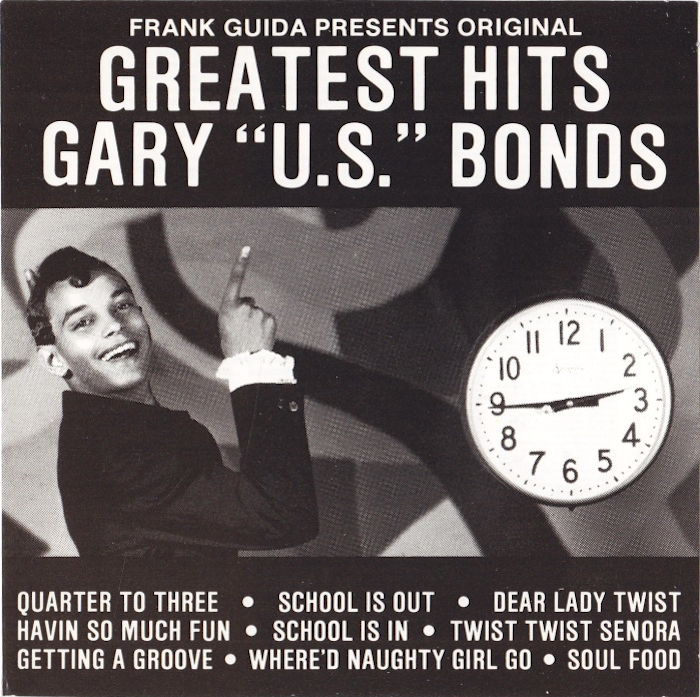
Time To Rock
Not Me, Gary’s raucous follow-up, failed to chart altogether. Credited to Bonds and Guida, its raunchy narrative cost it some airplay. “I think it sold a lot more by being banned,” says Gary (a remake of Not Me by the Philly-based Orlons was a major hit in 1963). But Bonds rebounded with the biggest seller of his career in the spring of ’61, basing his song on a recent Legrand instrumental issued under the name of Guida’s house band, the Church Street Five – Gene Barge was showcased on both parts of the roaring A Night With Daddy ‘G’.
“They put it out, but it really wasn’t doing anything as an instrumental,” explains Bonds. “Everybody was saying, ‘Well, you know it’s got a groove to it, but it needs lyrics.’ So Frank actually said: ‘Kid, why don’t you put lyrics to it?’ So I went in the other room, got my little pad and paper, wrote down some stuff right quick and I guess about 20 minutes later, I got something. And then we went in and recorded it just like it was. We were all in the studio; the band and everybody was there, we were just sitting around drinking, as we always did, and then we recorded it with the lyrics.”
From such informal beginnings sprang the rollicking Quarter To Three, its lyrics mentioning Daddy G prominently. “I figured I had to. It was his song!” says Gary. Guida made the record sound like it was cut at a rowdy party. “That was my full intention: to do Quarter To Three as you would if you were going by the black churches and hearing the excitement,” said Guida later. In June of 1961, Quarter To Three was No. 1 in the US for two weeks. It was Gary’s top seller on these shores as well. There was no longer any need to hide Gary’s racial makeup. “After Quarter To Three became a hit, we figured: ‘Well, okay, now what are they gonna do?’” he says.
A Formidable Force
Bonds and Barge proved a formidable writing team, beginning with Gary’s next hit later that summer, the celebratory School Is Out (which restored his first name to his billing). “Gene was a schoolteacher, so when he and I were sitting in the bar, he was always complaining about the kids and school,” says Bonds. “So we did a lot about school, because that’s what we talked about a lot.”
Naturally, Bonds’ next hit that autumn was School Is In. To keep the theme going, he’d later wax Mixed Up Faculty and No More Homework. Along with Barge, the Church Street Five included drummers Emmett ‘Nabs’ Shields and Melvin Glover, bassist Ron Fairley, pianist Willie Burnell, trombonist Leonard Barks, and paraplegic guitarist Wayne Beckner: “He had no legs, so he used to get around on a little skateboard-looking thing.”
Guida’s love for calypso music surfaced on Gary’s last pop charter of 1961, Dear Lady Twist. “He was influenced by a lot of the Caribbean music, and he gave it to us,” Bonds recalls. “But the other good thing about it was once he gave it to us, he got out of the way and let us work it from there.” Tucked on the flip was one of Bonds’ wildest rockers, Havin’ So Much Fun. “We really were,” says Gary, whose voice was usually double-tracked. “We’d bounce the whole thing, and then I’d put another vocal on it, because we only had two tracks.”
Let’s Twist Again
Twist, Twist Senora kicked off 1962 in chartmaking fashion for the young singer, and he made his cinematic debut that year in British director Richard Lester’s musical It’s Trad, Dad!, lip-synching the Doc Pomus/Mort Shuman-penned rocker Seven Day Weekend, his last solid seller for Legrand. There was no trip to the UK for filming. “We did my part in New York. It took about 10 minutes,” remembers Gary. “I went to see the movie, they showed it in my hometown. God, it was awful. I got out of town right after that!”
Bonds threw down the gauntlet at his rivals in Copy Cat, which barely charted in late summer of 1962. “We got a lot of flack behind that one, because we were actually saying that most of the people that were coming up after we started were really trying to do what we were doing, especially out of Philadelphia,” he says.
Despite more blazers, Where Did That Naughty Little Girl Go (with Gary threatening to rupture his vocal cords and Barge matching him for excitement), in particular, deserved a better fate in late ’62. That was the end of Bonds’ first chart run.
A bizarre two-part 1963 vocal revival of Duke Ellington’s jazz standard Perdido soured Bonds on Guida. “That was the straw that broke the camel’s back. That was the one. I went: ‘You know what, Frank? I can’t do this crap no more,’” he says. Bonds nixed Guida’s proposal to revive the calypso standard If You Wanna Be Happy. “He wanted me to do it,” says Bonds. “I went: ‘Nah, I don’t want to do that.’” Guida steered the song to Gary’s old pal Jimmy Soul, whose buoyant reading topped the 1963 pop hit parade.
Frank Guida continued to release Bonds singles into 1968, although many were done prior to the Perdido blowup. The thundering Take Me Back To New Orleans, released in 1966, and several more, merited a higher profile.
With Barge now gone, Bonds found a new writing partner in the multi-talented Jerry Williams Jr, known as Swamp Dogg. “Swamp Dogg lived around the corner from me. I knew Swamp Dogg for years,” says Bonds. “Then he moved to New York. When I moved to New York, we hooked up again.” Although the late-60s Bonds singles that Swamp produced for the Botanic and Atco labels went nowhere, the duo wrote hits for Freddie North, Doris Duke, and Dee Dee Warwick.
Meeting The Boss
Gary kept working on the strength of his early hits throughout the 1970s. Then Bruce Springsteen, an avid Bonds fan as a teen, came into his life. “Bruce came down to see me in a club when I was working in Jersey. He sat in with me at the club,” Bonds remembers. “Then we met up the following week. I think he had to work at some small arena there in Jersey. He said: ‘Hey man, you want to come down and do a couple of numbers with me?’ I said: ‘Yeah, okay, I’ll get over there,’ because I wasn’t that far from Jersey.
“We got to the point where he wrote a song. He called me up, he said: ‘Man, I’ve got this song I’m doing. I’m in the studio right now, and it sounds so much like you. You’ve got to come down and listen to it. If you want to do it, come on in and do it!’ That was Dedication. Once we did that, he said: ‘Look, let’s do an album!’”
With Springsteen and Miami Steve Van Zandt producing, Dedication was Bonds’ first album in almost two deacades, and a 1981 smash on EMI America, rendering him a star all over again. Its first single, the Springsteen-penned rocker This Little Girl, just missed the Billboard pop Top 10. “That was written halfway through in the studio by Bruce,” remembers Gary. “I think the other half was written on the way to the studio. The guy’s a genius.” [Ed’s note: Springsteen later said many of the songs were written for his 1980 album The River, but he always felt they’d be better with Bonds singing them.]
Springsteen and Van Zandt also produced Bonds’ 1982 follow-up set On The Line, which featured another Bruce-authored hit, Out Of Work (US pop No. 22).
Fast forward to 2018, and his wife and daughter, both named Laurie Anderson, have long been backing singers in his band, The Roadhouse Rockers. His spouse, once known as Lucy Cedeno, had been one of the doo-wopping Love Notes, a New York group that waxed United, a Top 20 R&B hit for the Holiday label in 1957. She then cut a solo single, Make Me Queen Again, for George Goldner’s End label in ’59 (renamed Lucy Rivera) and Don’cha Shop Around (an answer song to The Miracles’ Shop Around) a couple of years later, as Laurie Davis, for Guaranteed.
The two met in Atlantic City back in the 60s. “She was working there as Laurie Davis at the time and I was working some club around there,” says Bonds. “She came down to see me, and we sat around and talked later. I told my road manager at the time: ‘I’m gonna marry that woman right there!’ And I did. That was 55 years ago.” Now that’s dedication.
For more on Gary US Bonds click here
Read More: Spotlight On Soul – The Blues Brothers