
In our lowdown on Billy Fury, we look at how one of the brightest lights in Larry Parnes’ stable of stars remains a true icon of British rock’n’roll, whose passion and talent left an unforgettable mark on music history. Sadly, ill health led to an early death aged 42, but his appeal endures…
There’s little consensus across the generations on the merits of early British rock’n’roll. One view, usually favoured by those who were around at the time, is that even a mediocre platter by Johnny No-Hit from Oklahoma had to be way more exciting than anything out of a rainy old Britain just off the ration books. But another opinion, often held by those of us of a later stock, is that you must have cement in your ears not to get a kick out of Tommy Steele, Drifters-era Cliff Richard, Marty Wilde, Johnny Kidd & The Pirates and several notable others. What everyone seems agreed on, however, is that Liverpudlian Billy Fury was special. As Colin Kilgour put it on his now defunct BlackCat Rockabilly Europe website, he “was the greasiest, sexiest, most angst-ridden Brit-rocker of them all.”
Born Ronald Wycherley in 1940, although a shy man off stage, on it he was transformed into a raging sexy beast. His face contorted and his oddly angular shoulders hunched, while his hands involuntarily jerked out to the sides as if operated by an unseen puppet master.
Raw Power
The first British rocker to make overt use of the lower half of his body as part of his act, it went down a treat with his female audience. Not classically handsome, he was an amalgam of imperfections that made the perfect whole. The opposite of the clichéd dark, brawny rocker, he was fair and pimply.
He suffered from poor health and could seem frail. He had high cheekbones, a cute ski-slope nose and a pointy chin, but in some shots he looked lantern-jawed. He was polite and soft-spoken to the point of dull with interviewers but, as a former deckhand on a Mersey tug, you sensed he could take care of himself.
Fury had a deceptively successful UK recording career for Decca from 1960 to 1966. Although lacking a No.1 single, only Elvis, Cliff and The Beatles (who he rejected as his backing band as likely to be too much trouble) outsold him. But he was mainly a star of the pre-beat era.
Two things stand out. The first is that, while there was good British rock’n’roll around back then, there wasn’t much of what we’d now recognise as rockabilly. But there are tracks on The Sound Of Fury album that meet the criteria in a British sort of way. Few now doubt it was the first great British rock’n’roll album. The other thing is Fury’s voice. Decca’s shift to recording him on beat ballads, often lamented, was no commercial or creative disaster as he had an uncanny ability to project a note of melancholic, almost claustrophobic, yearning into a song.
They say the music died in between 1959 and 1963, but it never sounded dead when Billy Fury was singing.
KEY SONGS

Maybe Tomorrow
Talk about hitting the ground running. The Fury vocal style, with its air of loneliness and longing, is already present on his first Decca single, released in January 1959. A self-penned ballad, the arrangement from Harry Robinson is suitably plaintive. The B-side Gonna Type A Letter is another gem, the heavy beat, parping sax and ‘typewriter’ effect typifying the fabulous big sound emanating out of the era’s British studios.

Don’t Knock Upon My Door
There was a two-way pull in Fury between the raucous, lip-curling rocker and romantic beat-ballad crooner. By popular demand, the latter won out, but his shows delivered the rockin’ goods. You can just see Fury writhing before banks of shrieking women as he yells his way through this one. The production is typical of the rousing ‘kitchen sink’ approach in British rock’n’roll at the time.

That’s Love
Followed hot on the heels of Fury’s first Top 10 hit Collette, this was lifted from The Sound Of Fury, as was the flipside ballad, the achingly wistful You Don’t Know. The choice indicates the pop market of the time because, unlike some of the other album tracks, That’s Love is an amiable lope through the country/rockabilly borderlands, not an outright rocker. The relaxed vibe is expressed in Billy’s exclamation, “That’s love, fellas!”

Turn My Back On You
Of all the numbers on The Sound Of Fury, this is the one that screams rockabilly. The track was recorded at an earlier session to the other album tracks. It also saw release on an EP. Heavy on the slapback echo effect, with Joe Brown playing Scotty Moore-style guitar, this is Fury’s homage to Sun Records-era Presley, a point made clear when he performed it live on TV, back-to-back with Baby Let’s Play House.

Wondrous Place
A strange minor key song that represented a change of approach by Decca towards Fury’s singles. Despite the quality of his writing, the platters had underperformed saleswise, so they shifted him onto songs either first recorded or written by others. In fact, Wondrous Place, a non-charter for Jimmy Jones in the States, only made No.25 in the UK for Fury. But he rated it enough to record several versions and it’s a fan favourite.

Halfway To Paradise
Fury is said to have disliked this record, yet he admitted it proved a career turning point, lifting him from headliner on the Parnes package shows to standalone star. The New York Brill Building team of Gerry Goffin and Carole King wrote the song for Tony Orlando, but aside from Fury’s superior vocal, the stirring British studio production knocks the stolid American one out of the park. Take a bow co-producers Ivor Raymonde and Mike Smith.

I’d Never Find Another You
After the success of Halfway To Paradise, the emphasis shifted to romantic material. Even B-sides like Open Up Your Arms and Sleepless Nights, beautifully arranged, had a tender quality. I’d Never Find Another You made No.5. Fury’s sensuous croon is outwardly soothing, but there’s an almost haunted undertone. He lacked the semi-operatic heights of Roy Orbison, but no one in Britain did it better.

Don’t Jump
Reflecting the early 1960s mania for death songs, this outlier in the Fury catalogue was self-penned and recorded in mid-1961, when Decca was mainly concentrating on him doing songs by other writers for singles. So it appeared on the excellent EP Billy Fury No.2 the following year. Although the lyric presents a grim scenario, with a to-and-fro between Fury and the backing vocals about a suicide jump, there’s a twist at the finish.

A King For Tonight
The post-Sound Of Fury records tend to feature big orchestrations and prominent backing vocals rather than guitars but this track from 1962 is a thrilling exception, a fuzztone guitar well forward in the mix. A Doc Pomus and Mort Shuman composition, the equally excellent original was by Barry Darvell for Atlantic. Sadly, Fury’s version was only a flipside, but given its partner was the top-class Last Night Was Made For Love, we can’t complain.

In Summer
While the highly rated Like I’ve Never Been Gone and When Will You Say I Love You, both hits earlier in 1963, were in the melancholic Billy Fury style, this follow-up was upbeat. Yet although happy-themed, with a girlie chorus, the sadness is still there. Was it Fury’s health, his feeling that he wasn’t going to see many summers, that makes the song oddly nostalgic? The last of seven Top 5 hit singles between 1961 and 1963.
KEY ALBUMS
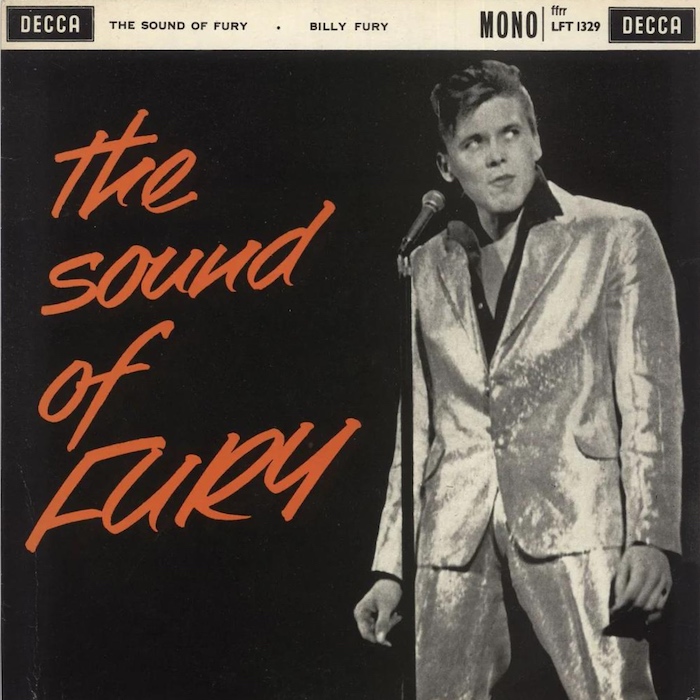
Billy Fury was an old school singles artist. Even if he’d wished it otherwise, health issues ensured a limited LP output. It’s therefore ironic that he was also responsible for one of the few outstanding rock’n’roll records to emerge from the early British scene.
The Sound Of Fury was issued in the 10″ format, rather than the usual 12″, in 1960. Uniquely for the time, Fury was permitted to write all the songs himself. There’s an edge in Fury’s voice, but it isn’t wall-to-wall rockabilly. Turn My Back On You and It’s You I Need fit the description. Since You’ve Been Gone starts out as blues but opens out into rockabilly. My Advice has Buddy Holly inflections. But what makes the album special is the balance and pacing, the inclusion of two quality rockaballads, and the occasional country and blues flavourings. Some, wrongly, have said the album sounds like it could have emerged from a Memphis studio. Actually, it’s precisely the fact that it sounds like something out of Britain that makes it distinctive and historic.

We Want Billy! (1963)
Although Fury always had Elvis-inspired mannerisms, he wasn’t defined by them. Joe Brown was asked to get close to the Scotty Moore sound on his guitar, but bass player Alan Weighell had been a member of Tommy Steele’s Steelmen and, along with the drummer Andy White, had also been in the house band for Jack Good’s ABC-TV show Boy Meets Girls. The doubling up of Weighell’s electric bass with Bill Stark’s slapped string bass was a brilliant British studio touch. Session pianist Reg Guest enriched the sound, notably on You Don’t Know and Don’t Leave Me This Way. The Four Jays’ backing vocals throughout the album are excellent.
Of the other albums, We Want Billy! (1963) was recorded in front of a studio audience with The Tornados, a hot item in their own right, just off the back of their hit Telstar.
FURY ON FILM
Fury’s biggest movie was the 1962 musical Play It Cool, which gave a young Michael Winner an early chance at directing a feature film. Fury was in his smouldering pomp, and the opening sequence, the title track belted out against a darkened backdrop, evoked early Elvis. Endearingly, even as the star, the soft-spoken Fury carried a forlorn air, for much of the film resigned to not getting the girl. The tender ballad Once Upon A Dream was a big hit. There was an excellent scene with Shane Fenton, and songs by Helen Shapiro, Bobby Vee and Danny Williams.
I’ve Gotta Horse (1966) drew upon Fury’s equine interests – the colt Anselmo having run in his colours at Epsom in the 1964 Derby, defying odds of 100-1 to finish fourth. Fury memorably played the louche rocker Stormy Tempest in That’ll Be The Day (1973), though by then the heartthrob of the day was David Essex.
ESSENTIAL READING

The first biography of Billy Fury, Wondrous Face – The Billy Fury Story, published in 2005, was by Spencer Leigh, fellow Liverpudlian and BBC Radio Merseyside broadcaster. As one would expect from this author, an authority on so many aspects of pop music, it was good on Fury’s recorded material, though the star’s family criticised it for presenting an unfavourable picture of his complicated private life.
In 2018, Halfway To Paradise: The Life Of Billy Fury emerged from the husband-and-wife writing team of David and Caroline Stafford. Again, here were two writers returning to territory previously visited, albeit via their biography of the somewhat less seminal Adam Faith, Big Time: The Life Of Adam Faith (2015). A useful online repository of Fury information is www.billyfury.com, with links to the Sound Of Fury Fan Club, run by leading authority Chris Eley.
THE STYLE OF FURY
Some music reviewers have adopted a sneery attitude to Billy Fury’s output, presenting him as a would-be Elvis type forced by his bosses to sing saccharin love ballads. It’s not entirely wrong. Fury clearly relished the studio moments when he was able to cut loose on something more biting. But listening to him is always a nostalgic experience. Even the later re-recordings from the 1970s reflect an artist whose greatest years were before the 1960s beat explosion. He was born the same year as John Lennon and Ringo Starr, but his style was that of another era.
It’s easy to forget that at one time he was quite controversial, berated for his suggestive stage moves. “Some of his antics during a ‘love scene’ with the microphone were downright disgusting,” fumed the New Musical Express after one of his earlier shows. He was definitely too steamy for Ireland in 1959, where his tour was stopped midway through, and he was told he would never be welcomed in the country again.
King For Tonight
There doesn’t seem to be much footage of the “leadpipe down the trousers” years, so one of the few glimpses we get of Fury as the salacious rocker is his tiny cameo in That’ll Be The Day as Stormy Tempest. You can’t take your eyes off him, but he looks as delicate as bone china, and when he finally gets some dialogue, we hear that sweet, polite voice so totally at odds with the public image.
It’s simplistic to paint him as gnawing the glove because he couldn’t sing more rock’n’roll. Frankie Laine was an early hero, hence his brilliant re-recording of the latter’s Jealousy. Physically, he had more of the fragile, lithe appeal of Johnnie Ray. The strange twitches might have been derived from him as much as Elvis.
Although Fury forged a distinctive style, he was fortunate in his musical directors. Jack Good produced many of Fury’s early recordings, including the tracks for The Sound Of Fury and singles like Wondrous Place. Harry Robinson supplied the arrangements on the early sessions that yielded Gonna Type A Letter and Don’t Knock Upon My Door. Ivor Raymonde was key to the knockout productions of Halfway To Paradise, I’d Never Find Another You, and songs related to the film Play it Cool. Mike Smith is credited with producing the underestimated Running Around.
Read More: Classic Album – The Sound Of Fury