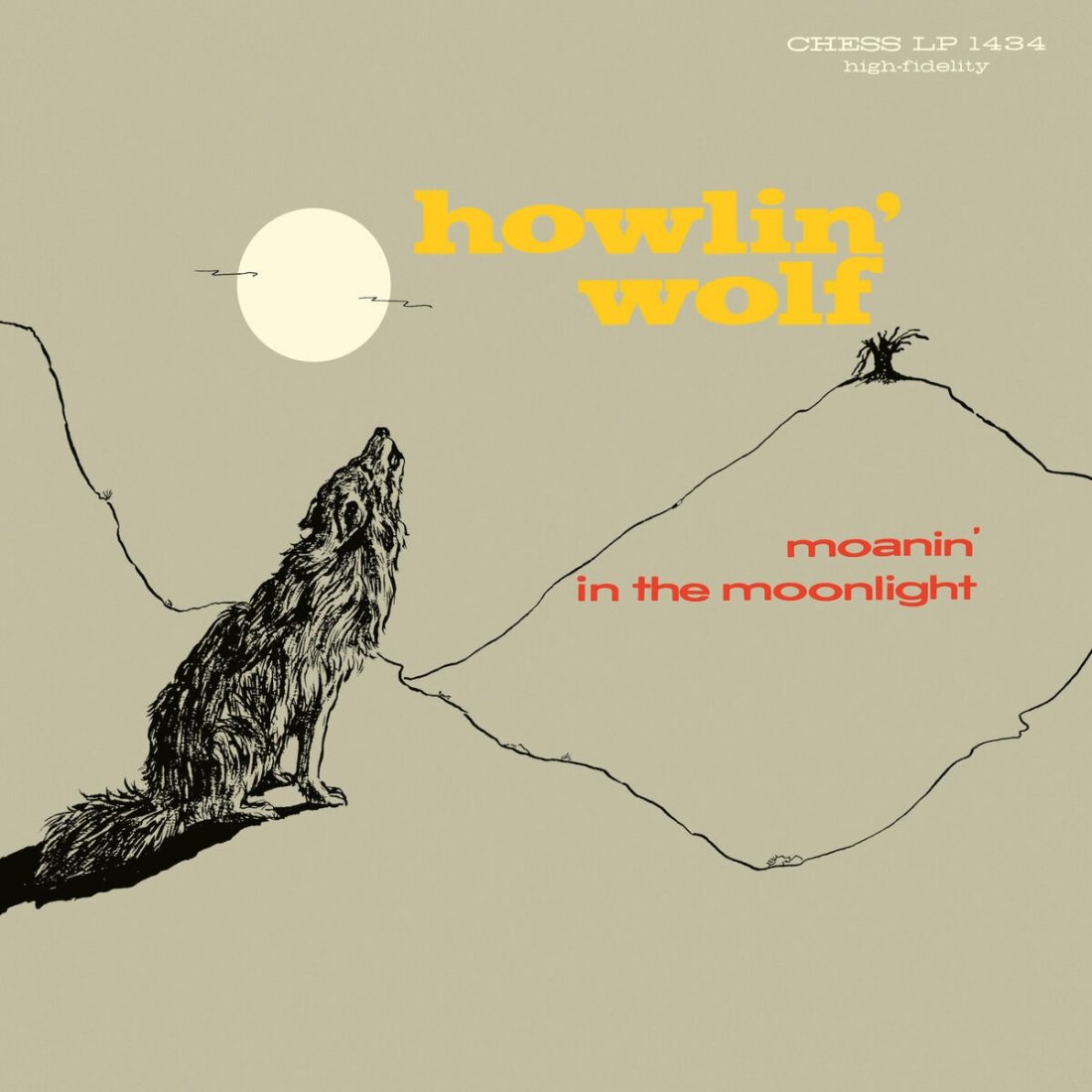
A compilation of sensational Howlin’ Wolf tracks released on Chess between 1951 and 1959, rather than a studio album, this collection of authentically gritty blues shows why Chester Arthur Burnett was so beloved of the British beat bands in the 1960s.
In 1965, at the age of 54, Howlin’ Wolf was finally, truly heard. The man born Chester Arthur Burnett worked as a farmer in his native Mississippi until the age of 40, playing music as a sideline. Imagine his surprise, then, when the gritty blues that he recorded for Chess Records throughout the 1950s proved to be an enormous influence on chart-topping British beat bands in the following decade.
Wonderful Movement
After The Rolling Stones scored a UK No.1 with a cover of Little Red Rooster and were booked on the American TV show Shindig!, they insisted that the Wolf, who had released the blues standard via Chess Records in 1961, should appear alongside them. This would be Burnett’s only national American TV performance.
Brian Jones and Mick Jagger make giddy introductions before the man himself – all 6ft 3in of him looking weather-worn but elegant in a dark suit – waltzes up to the microphone. Apparently unfazed by the experience, he growls through a louche rendition of How Many More Years, the B-side to the slightly more rambunctious Moanin’ At Midnight, his debut single released on Chess in 1951. The author Peter Guralnick described this as “one of the most significant moments in cultural history – part of a wonderful movement that couldn’t be turned back”.
That “wonderful movement” was embodied by the white teenagers gathered around the Wolf, keeping time by clapping along to a blues originator they were clearly in awe of. In their home country, the likes of Howlin’ Wolf and his long-time rival Muddy Waters had not exactly received the sustained acclaim that they deserved.
To British rock’n’rollers, however, they represented everything authentic, exciting and perhaps even magical about the blues. In Wolf’s case, this was partly thanks to Moanin’ In The Moonlight, the sensational 12-track compilation of his largely self-penned Chess recordings from 1951-1959.
Heading North
The 1959 LP was a glorious victory lap for all that Burnett had achieved through the last, disruptive decade. He was born in White Station, an indistinct stretch of Mississippi located between Jackson and Memphis, in 1910. Perhaps he was always destined for greatness, considering he was named after Chester A. Arthur, the 21st President of the United States. His grandfather called him the Wolf, he explained: “because I was a bad boy… He told me the story of [what] the Wolf [did] to Little Red Riding Hood”. Nowadays, we might say Burnett ‘reclaimed’ the nickname, that must have been confusing for a boy who was also named after a President.
Having grown up on a Ruleville cotton plantation, he travelled and performed around Mississippi with the mythical Robert Johnson, who played guitar while the Wolf sang. When, in the aftermath of World War II, mechanisation deprived cotton-pickers of a livelihood and decimated the juke joints he performed in, the Wolf headed north to Memphis. Much of the city imposed an 11pm curfew on its Black citizens, but West Memphis promised all the juke joints, money and loose living that a ‘“bad boy” blues musician could dream of.
This is when that nominative determinism kicked in, as Chester Arthur Burnett collided with a fellow great, Sun Records founder Sam Phillips, who was tipped off to listen in as the singer performed on the KWEM radio station. “[He was] one of the greatest artists I ever recorded in my life,” Phillips said in an interview that appeared in the 2003 documentary The Howlin’ Wolf Story: The Secret History Of Rock And Roll.
It was some statement from the man who discovered Elvis Presley. Yet one only has to listen to Moanin’ At Midnight and How Many More Years, the two songs that open Moanin’ In The Moonlight, to know what Sam Phillips heard in Howlin’ Wolf. The singer was influenced by the yodeller Jimmie Rodgers, whom he attempted to imitate. He struggled to pull off the technique and settled instead for his gravelly, haunted yowl. “I couldn’t do no yodellin’”, he once explained, “so I turned to growlin’, then howlin’, and it’s done me fine.”
Hardship & Toil
With Ike Turner on piano, Wolf sounds spooky and possessed on these tracks, his voice guttural and rich, steeped in the pain, defiance and stoicism that the man himself had exuded through years of hardship and toil. “Blues is problems,” Howlin’ Wolf was quoted in the record executive-turned-author Arnold Shaw’s Honkers And Shouters: The Golden Years Of Rhythm And Blues. “Singing about them doesn’t make things easier. It just takes your mind off it. You singing ain’t gonna help you none. The problem is still there.”
Before he launched Sun Records in 1952, Sam Phillips recorded songs at his Memphis Recording Service and leased them to the likes of Chess. So it was with Moanin’ At Midnight and How Many More Years, both of which feature Willie Johnson on guitar (Robert Palmer once claimed that the latter featured the first-ever “distorted power chord”). Recorded in July 1951 and released the following month, the A-side prowled its way to No.10 on Billboard’s Most Played Juke Box R&B Records chart by November.
This sparked a bidding war between Chess Records and the Bihari brothers’ RPM Records. When the former came out on top and the Wolf reaped the spoils, he drove to Chicago with $4,000 – a small fortune at the time – in his pocket.
Burnett enjoyed even greater freedom in Chicago than Memphis had to offer. Here, too, were the headquarters of Chess. “The artists wanted to be on [the label] because they wanted to make money,” explained Marshall Chess, son of the imprint’s co-founder Leonard in the documentary The Howlin’ Wolf Story: The Secret History Of Rock And Roll. “They wanted a hit. And we wanted hits!”
Laying The Foundations
Indeed, the Wolf had come so far from Mississippi and was hungry for even more. He would have to wait, though. The incongruously sprightly No Place To Go and the serrated Evil, sometimes listed as No Place To Go (You Gonna Wreck My Life) and Evil (Is Going On), both recorded for Chess in 1954, epitomise all that was great about Howlin’ Wolf, but they had little impact on the charts. Yet Chester Burnett was smart and ambitious and, alongside his recording sessions and live performances, he enrolled in formal education for five years. Here, he studied music and gleaned literacy skills he had not been taught in childhood.
What followed would cement his legacy forever. The Wolf described his 1956 song Smokestack Lightnin’ as being about “a train that’s on the railroad”, and certainly there is a slow, determined sense of movement to the song, which demonstrates greater musical sophistication than his previous releases. Over a steady riff that courses insistently through the track, he sings mournfully, “Stop your train/ Let a poor boy ride/ Why don’t you hear me cryin’?”, before letting out a resigned exhalation that sounds like a steam train whistling by.
It’s the definition of an American classic that sounds less like it was written than dug out from the soil beneath his feet. Almost seven decades since its release, Smokestack Lightnin’ is Howlin’ Wolf’s biggest hit on Spotify, having amassed more than 80 million plays.
When the song was selected for preservation by the Library of Congress for the National Recording Registry in 2009, his biographers James Segrest and Mark Hoffman wrote in a joint essay: “Saying Smokestack Lightnin’ was a song about a train is like saying Citizen Kane was a movie about a sled. It was not so much a song as a mood: insubstantial as a smoke ring melodically and lyrically, yet gigantic as a gathering storm in rhythm and power.”
Outrageously Cool
That it doesn’t overshadow Moanin’ In The Moonlight is testament to both the album and the man who laid down its tracks. Moanin’ For My Baby (recorded in 1958) crackles like static, while his take on Roosevelt Sykes’ version of the blue standard Forty-Four (1954) thumps along in the manner of chain gang, each of them still sounding outrageously cool.
Howlin’ Wolf worked in an established blues tradition, yet his songs were so influential because of their innovation. Arnold Shaw noted in Honkers And Shouters that Wolf incorporated traditional “boogie shuffles” and “hammering triplets”, but would also repeat a “short, rhythmic phrase” throughout tracks such as Smokestack Lightnin’ and No Place To Go…. The effect, he wrote, was “mesmerising”.
In the Alastair Mckay article Cosmic Ceiling Tiles, Elvis Presley, And The Abiding Genius Of Sam Phillips: What Made Sun The Crucible of Rock’n’Roll?, acclaimed producer T-Bone Burnett opined that How Many More Years could be described as “the first rock’n’roll song.”
He claimed the track, “has the guitar lick that became the central guitar lick in rock’n’roll, and that’s the first time we heard that played on a distorted guitar. It was an old big-band lick, turned into something completely fresh”.
Members of The Rolling Stones would appear on Burnett’s 1968 album The London Howlin’ Wolf Sessions, but it’s Moanin’ In The Moonlight, with its unforgettable artwork from Chess Records’ in-house art director Don Bronstein, that remains the enduring totem of his legacy.
These tracks are rockin’ in their own right, but also for the revolution they inspired. “When we first started playing together,” Brian Jones confided in host Jack Good on that episode of Shindig!, “we started playing because we wanted to play rhythm and blues. And Howlin’ Wolf was one of our greatest idols.”
Stream Moanin’ In The Moonlight here
Read More: The 50 Greatest Albums Of The 1950s