A true Architect Of Rock’n’Roll, Little Richard burst onto the scene with a sound and spirit that refused to be contained.
With his electrifying piano, flamboyant style, and unmistakable voice, he turned every performance into a joyful explosion of rhythm and rebellion. Bold, fearless, and unapologetically original, he wasn’t just a star; he was a force of nature who helped define the very heartbeat of modern music. Little Richard songs like Long Tall Sally, Good Golly, Miss Molly, Rip It Up, Lucille, Keep A-Knockin’ and, of course, Tutti Frutti, didn’t just climb the charts – they shook the foundations of popular music and inspired generations to come.
It’s been seven full decades since Richard Wayne Penniman enjoyed the peak of his powers. It was in October 1955 that the piano pounder unleashed Tutti Frutti, his seismic first hit single, while he famously quit rock’n’roll stardom at the height of his fame just two years later. Having renounced the “Devil’s music” to join a Christian college in Alabama, he soon released a string of underrated gospel records.
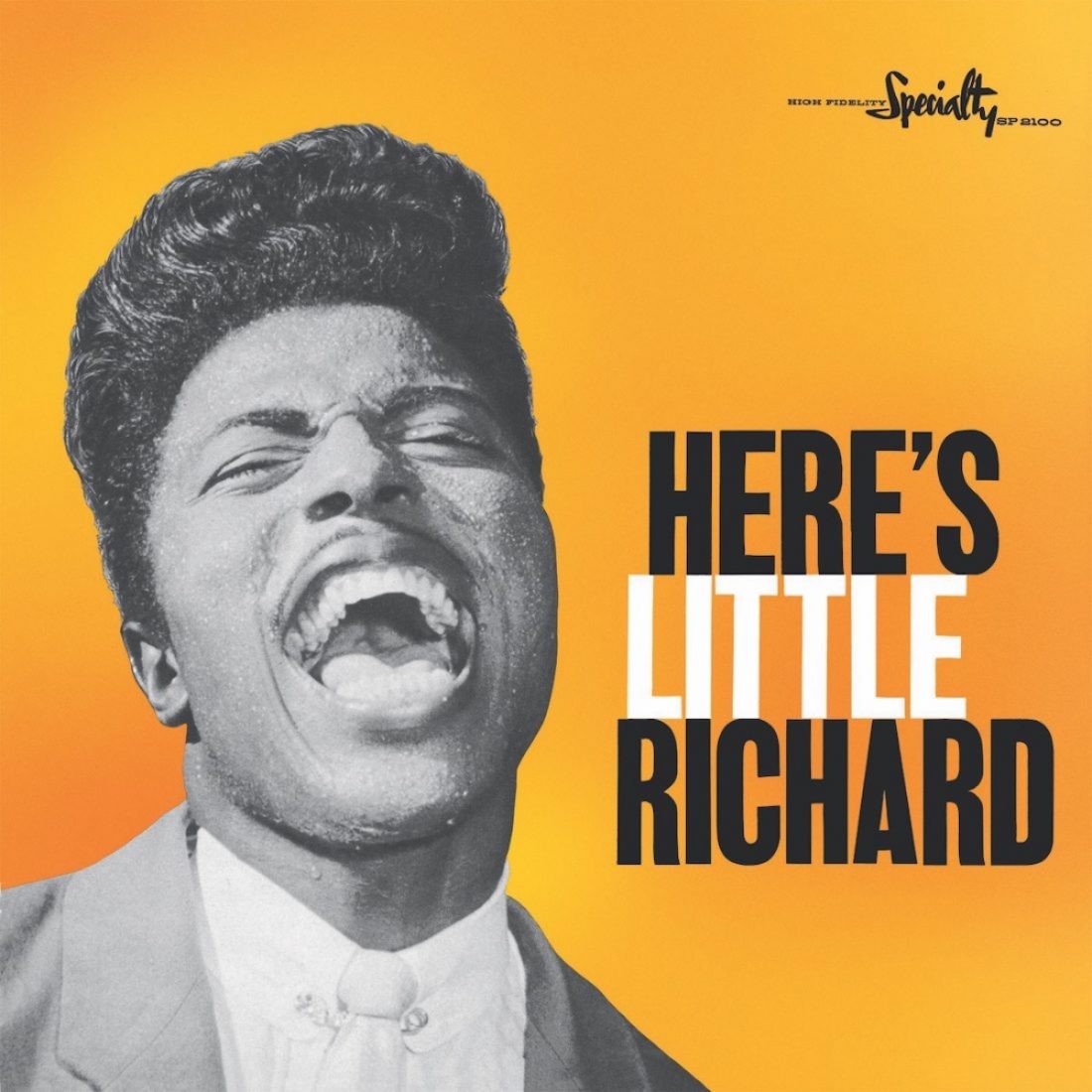
1956, though, was Richard’s year. Tutti Frutti and his religious epiphany bookended a remarkable period of productivity, musical innovation, hysteria, fame and its attendant pitfalls. He may have released classic singles such as Lucille and Good Golly, Miss Molly (as well as his timeless debut album Here’s Little Richard) between 1957 and 1958, but all of these hailed from red-hot recording sessions held in ’56. Some 70 years on, that hot streak continues to blaze.
Early Days
There is a fabulous photo that depicts a young Richard Penniman, in the early 1950s, rocking a shimmery cape as he fronts a band at Ann’s Tic Toc, a queer-friendly club in his native Macon, Georgia. Born in 1932, Richard would have been in his late teens or early twenties at the time.
Looking at the snap, you almost want to reach out to the fledgling musician and breathlessly inform him of all that is about to follow – how he’ll revolutionise rock’n’roll, make some of the most joyous records ever heard and ship his poverty-stricken family out to Hollywood. “Think about the people that came after him,” marvels Richard’s cousin Stanley Stewart, who resides in Macon. “Otis Redding, Jimi Hendrix, James Brown, The Beatles, The Rolling Stones. All of those people were connected to him. He was the true Architect Of Rock’n’Roll.”
Alas, Richard had needed to overcome a great deal of prejudice and pain before he could even get onstage at Ann’s Tic Toc, a local joint that he regularly frequented before fame beckoned. Richard’s father, Bud, was a preacher and a moonshiner who would brutally abuse his son for being effeminate. Luckily, Macon harboured a thriving underground queer scene that nurtured the fledgling star. It was here that he briefly became a drag queen (his moniker was “Princess Lavonne”) and rubbed shoulders with queer cohorts who offered the bisexual Richard comfort at a time when it was illegal to be gay.
One of 12 children, Richard grew up in a small, one-bedroom home in the Pleasant Hill district of Macon – space was so cramped that Richard and his siblings slept in bunk beds in the hallway. That is according to Robert Banks, the former administrator at the Little Richard House, a museum about the Architect that is located in said childhood home. “His story speaks to a person,” notes Robert, “that was trying to be himself at a time when who he was wasn’t necessarily accepted as much.”
Ready To Rock’n’Roll
In the early 50s, Richard Penniman was perhaps in search of validation. He tasted success with 1951’s Every Hour, a smooth R&B track recorded for RCA Camden in Atlanta. The track was a moderate hit in Georgia, which went some way to improve the singer’s relationship with his father, but worldwide fame would have to wait.
For the time being, he toured the South with The Upsetters, the band he recruited on the Chitlin’ Circuit, belting out tried-and-tested hits by the likes of Roy Brown and VR fave Fats Domino. In early 1955, during a break from the rigours of the road, hanging out at the Macon City Auditorium, he spotted Lloyd Price, the Louisiana legend who’d hit the big time with 1952’s majestic Lawdy Miss Clawdy. When Richard implored Price for advice, the star suggested that he contact Speciality Records, the L.A.-based label that had released the aforementioned hit.
What followed is one of the greatest stories in rock’n’roll. Richard mailed out a tape of scratchy demos, including a gorgeous self-penned ballad entitled Wonderin’, and waited… and waited. Eventually, after he relentlessly phoned the Speciality office to enquire about his tape (which he inauspiciously wrapped up in a ratty sheet of paper), he was summoned to New Orleans’ J&M Studio. Here he met Bumps Blackwell, a Speciality producer with as little experience as the singer.
Blackwell was taken aback by the singer’s towering pompadour, flamboyant clothes and fast-talking demeanour, but knew instantly that he was in the presence of stardom. “They just clicked really well,” the late producer’s daughter, Kelly Lee Blackwell, once told this writer. “They had the same mindset of: ‘This is great music that we’re going to put out.’ We are going to change the world musically – we’re going to put out something that no one has ever heard.’ My father saw Richard as: ‘I know this man is going to be great. I can see it.’”
Rip It Up
Blackwell was disappointed, however, that Richard’s meek performance in the studio didn’t match his “mega-personality”, as he described to author Charles White in 1984’s The Life And Times Of Little Richard: The Authorized Biography. So, they took a breather and headed down to the Dew Drop Inn, another queer-friendly joint where Richard would feel right at home.
Away from the pressure of the studio, amongst his people, Richard sat down at the club’s piano and let rip with a filthy tune that drew a roar of approval from the audience. The song was absolutely rollicking, with the singer hammering the piano keys as if intent on breaking them in half, but Blackwell knew that the tune’s X-rated lyrics wouldn’t fly on the radio. “Tutti Frutti,” Richard bellowed, “good booty/ If it don’t fit, don’t force it/ You can grease it, make it easy.”
With time in the studio running down, Blackwell whisked Richard back to J&M, enlisted a hopeful songwriter named Dorothy LaBostrie to clean up the lyrics (that “good booty” became the much more wholesome “oh, rootie!”) and, in just two takes, cut the song that changed the world. As we celebrate the track’s 70th anniversary, it’s remarkable how fresh, original and full of life it still sounds, from Richard’s opening war-cry (“Wop-bop-aloo-bop-alop-bom-bom!” indeed) to the joyful skronk of that first sax solo, ushered in by another of the singer’s wild yelps.
We Ain’t Fakin’
Charles White, whose book is not only the definitive tome on the Georgia Peach but arguably one of the greatest music biographies ever written, names Tutti Frutti as his favourite Little Richard song. “It oozes his interpretations,” the author tells Vintage Rock. “It was the business. He didn’t have to fake anything. It was the real deal.”
Elvis’ That’s All Right, which was unleashed the previous summer, remains arguably the most influential single ever released, given that the King broke the mould by recording a Black R&B song (originally released by Arthur “Big Boy” Crudup) in what was then a white country style. When Chuck Berry reversed the formula with Maybellene, released in July 1955, he gave pop music another jolt. For all their genius, though, these songs have clear precedents.
That’s All Right sounds like a country song, even if the singer’s racial identity was controversially ambiguous at the time. What on Earth does Tutti Frutti sound like? There’s a hefty dollop of New Orleans R&B in there, for sure – especially given that the session players at J&M had all rocked with Fats Domino. And Richard’s manic vocal tics certainly channel 1940s jump blues shouter Louis Jordan.
Give Tutti Frutti a spin, though, and it remains totally unique, thanks to its runaway pace, uninhibited vocals and curiously jazzy percussion (courtesy of influential sticksman Earl Palmer); the song swings as much as it rocks. No wonder it steamrollered its way to No.2 on the Billboard R&B chart and even crossed over to No.21 on the pop list, inspiring covers by everyone from Elvis to The Beatles (the Fabs never recorded the song but reportedly included it in their repertoire in the early 60s).
Macon Amends
Alas, while Richard achieved his big break in 1955, it was also a difficult year on a personal level. He loved Macon, taking an endearing amount of civic pride in his hometown, and even in later life would namecheck the city to interviewers. In May that year, however, he was arrested for what he described as “lewd conduct”, a transgression that resulted in his banishment from Macon. In Richard’s version of events, he’d been engaged in group sex in a car. Thearresting officer, one Deputy Munn, wrote this up as “solisting prostution” (sic).
In his police mugshots, a heartbreaking pair of images, Richard looks bereft, his expression vacant and his face drawn. Strangely, in the accompanying arrest report, his build is described as “stout” when Little Richard was famously petite – the clue was in the name! – though at least his occupation is correctly listed as “music”.
Richard reportedly didn’t return to Macon for years – not until the early 1960s – having moved to Hollywood almost immediately after the success of Tutti Frutti. In 2005, he was finally officially welcomed back for a grand homecoming concert at the Macon Centreplex. “It really showed how much Macon really cared for him and loved him,” recalls Stanley Stewart, who adds that even before the healing concert, Richard never forgot his hometown: “Every time he talked to me, personally, on the phone, he would ask, ‘What’s really going on in Macon, Georgia, baby’”
Stanley says that the show was a turning point for Richard’s reputation in Macon, now a thriving and open-minded city with a rich seam of musicality: “That 2005 concert really sparked a lot of things. That place was packed that night. It sits about 10,000 people and he had people outside, so it was really packed. I think people just realise now this person is one of the reasons why Macon, Georgia is what it is.”
Good Golly, Miss Molly
In the immediate wake of Tutti Frutti, Richard was so busy that he hopefully didn’t have time to ruminate on the shame of his exile. He’d been summoned to Hollywood’s Radio Recorders studio in late November 1955, when he recorded, among other tracks, early versions of Long Tall Sally and Slippin’ And Slidin’. It wasn’t until February 1956, however, that he really began to hit his stride. Back at J&M, he cut the definitive versions of these tracks,
as well as Ready Teddy, Rip It Up, Miss Ann, I Got It and Hey-Hey-Hey-Hey! What a session!
In fact, it was bettered only by his final studio stint of the year. In mid-October, again at J&M, Richard and the band churned out half a dozen hit singles in just two days: Jenny Jenny, Baby Face, By The Light Of The Silver Moon, Send Me Some Lovin, Good Golly, Miss Molly and The Girl Can’t Help It. They even somehow managed to record subsequently released alternative takes of the latter two tunes.
Richard enjoyed five Top 10 hits in 1956 alone, performed in the iconic Jayne Mansfield rock’n’roll movie The Girl Can’t Help It (which is where that alternate version of its title track surfaced) and incited pandemonium with his raucous concerts.
Fame Game
Unfortunately, the frenetic pace couldn’t last. Richard attended a total of five hugely productive recording sessions throughout 1956, but visited the studio just twice the following year. While this can partly be attributed to touring commitments, it’s also true that his devotion to rock’n’roll was wavering. The singer believed that Speciality boss Art Rupe was underpaying him and questioned Bumps Blackwell’s prowess in the studio, claiming that the producer took the credit for his arrangements. (It’s worth noting here that Blackwell accurately asserted to Charles White: “There was nobody else that ever got a hit out of Richard but me.”)
Robert Banks, meanwhile, suggests that Richard may have struggled with his newfound mega-fame, which could have been another contributing factor: “I’m pretty sure he didn’t expect himself to be as big as he was. People can get just out of control when it comes to musicians – especially Little Richard, because nobody had ever seen anything like that before.”
In any case, the result was that, frustratingly, Rupe and Blackwell struggled to pin Richard down for sessions in 1957. And then, of course, the singer made his dramatic exit from rock’n’roll onstage at the Sydney Stadium on 12 October 1957, when he grandly announced his abdication to 40,000 crazed fans. He claimed that a fireball (which famously later turned out to be to the Russian satellite Sputnik) rocketed through the night sky as a warning from God. “If you want to be with the Lord,” he told the audience, “you can’t rock’n’roll too. God doesn’t like it.”
Little Richard wouldn’t record another secular song for almost six years, when he cut the funky, Sam Cooke-penned Well in April 1963. This wasn’t released until 1966, though it was preceded by his rock’n’roll comeback, 1964’s enjoyably unhinged Bama Lama Bama Loo. The King and Queen had returned to reign.
Divine Intervention
Ahmad Greene-Hayes, Associate Professor of African American Religious Studies at Harvard Divinity School and author of the upcoming book Little Richard’s Witness: Liner Notes On Black Religion And Sexuality, says that there was a strong precedent for Richard’s religious awakening: “The idea that God spoke to Richard – he had visions in dreams and could hear God – was very real to him. He would read his Bible and have these experiences. It was very embodied.
“Unless one is attentive to that level of Black religious belief, it’s really hard to understand that moment. But for someone who studies religion, it makes a lot of sense. Richard is in good company in a larger history of people of African descent having these really robust narratives of religious conversion. We trace that well into the 19th and 18th centuries, where you start getting accounts of religious conversion. What Richard narrates is no different from some of the accounts you see in a book called God Struck Me Dead, an edited collection of formerly enslaved people’s accounts of religious conversion.”
Green-Hayes concedes that Richard’s conversion may also have been influenced by his overwhelming celebrity and the controversy surrounding rock’n’roll at the time, as he perhaps sought the safety of the church, but feels that this isn’t the whole picture. After all, the singer spent the rest of his life ping-ponging between gospel and rock’n’roll, between camp flamboyance and chaste religiosity.
Lasting Legacy
“He feared that if he didn’t take heed in 1957,” explains Greene-Hayes, “he would die and go to Hell. That was very real for him, and I think it was very real for him for the entirety of his career, but he couldn’t reconcile that kind of theology with his lived experience. He was still attracted to men, he enjoyed partying, doing drugs and rocking. He couldn’t reconcile that with this theology that in some ways wanted to keep him in a box that he could never be in.
“He wasn’t masculine enough; he wasn’t calm enough. Everything about him was exaggerated. And yet the theological worldview of his background consistently wanted to keep him in line, keep him boxed. I think he would break out of the box and somehow reconstruct the box. Over and over. It was like, break the box and get back in the box. That’s the heartbreaking aspect of the story. It’s sad – I don’t think he ever reached a place where he truly felt at home in himself.”
It may be balm, however, to consider the enormously positive impact Little Richard had on the world. After all, David Bowie, one of the great creative geniuses of the 20th century, had his own religious epiphany upon hearing Tutti Frutti in the mid-1950s. “My heart nearly burst with excitement,” he once said. “I’d never heard anything even resembling this. It filled the room with energy and colour and outrageous defiance. I had heard God and now I wanted to see him.”
Many of us know exactly how he felt. In December 2023, this writer was lucky enough to visit Macon for an almost week-long celebration to mark what would have been Richard Penniman’s 91st birthday. One night, two Black drag queens danced onstage to Tutti Frutti and invited a young girl from the audience to groove along with them. Almost seven decades since he was banished from the city, this seems like a fittingly legacy for both Little Richard and the song that started it all.
Jordan Bassette is the author of Bloomsbury Publishing’s 33 1/3 series’ Here’s Little Richard buy it here.
Read More: Little Richard’s film career on the big and small screen