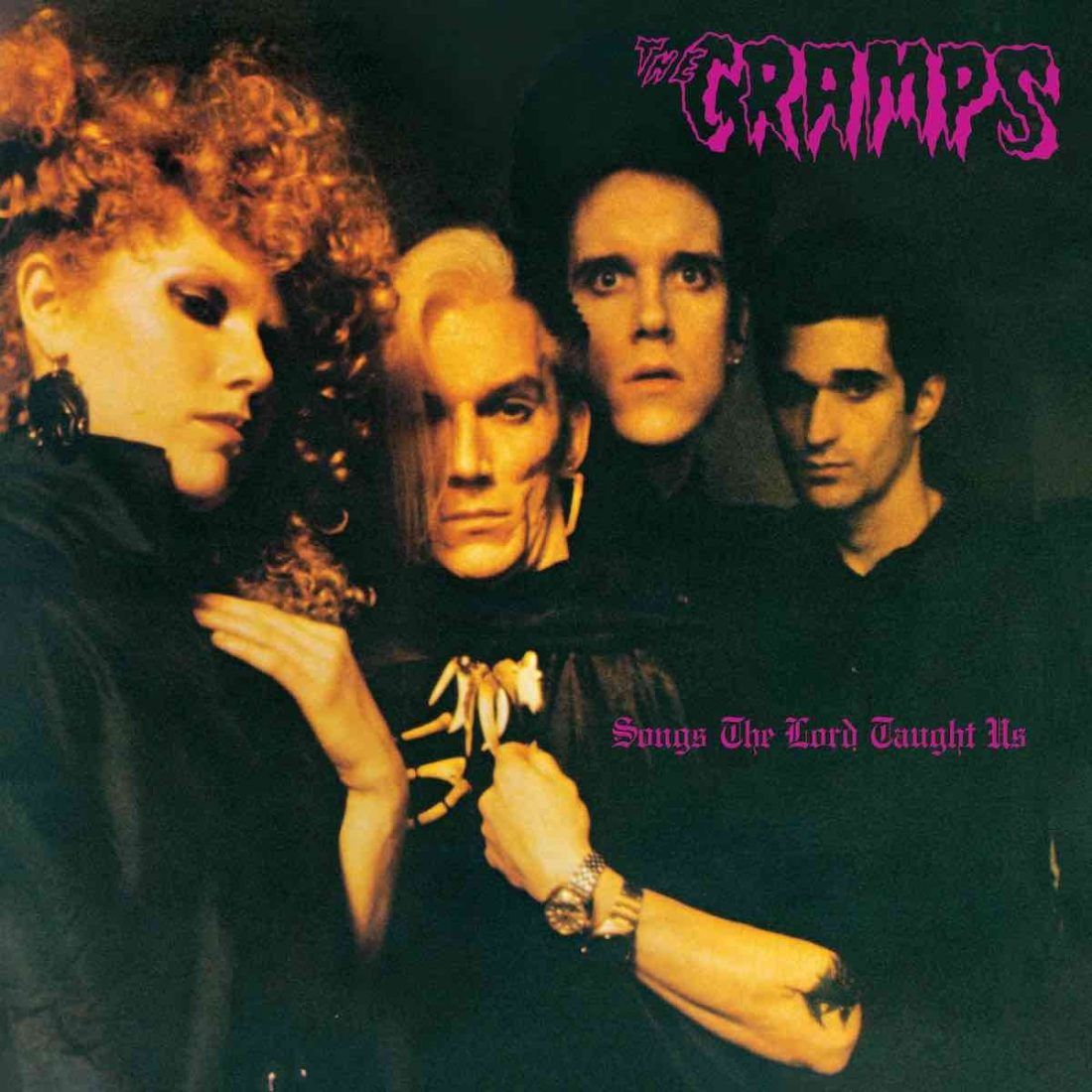
Born of rockabilly rebellion and deeply entangled with the punk era in which it was conceived, The Cramps debut album is the unrelenting thriller that birthed the psychobilly movement. Here Vintage Rock revisits a frighteningly good long-player…
The Cramps are a woefully underappreciated band. For one, they came out of the CBGB class of the 70s that brought us the likes of Television, Blondie, Talking Heads, Ramones and Suicide. But are The Cramps ever more than a passing footnote in the story? Not often. Perhaps they were that little bit too unhinged, too underground, too frightening, even for the nonconformists. But not only are The Cramps responsible for the birth of an entire genre, they were a band that counted within their ranks one of Uncle Sam’s most iconic females, a formidable figure that pushed the limits in a still horribly chauvinistic music world, just as her rock’n’roll cousins – the likes of Wanda Jackson, Alis Lesley, Lady Bo and Sparkle Moore – had before her.
If rock’n’roll had parents up and down the States reaching for their Bibles when Elvis first wiggled his hips, then the hoofed one was making his grand return for a new decade. And while those other great CBGB alumnus did plenty to expand musical horizons, none were as thrilling, visceral or damn right batshit crazy as The Cramps.
At the band’s core were a one-of-a-kind husband-wife duo. Erick Lee Purkhiser – deliciously renamed Lux Interior – cut a towering six-foot-five frame, his hair backcombed high, lurching around the mic as if one evaluation short of the insane asylum. From his mouth came lyrics bristling with imagery bound in Hammer horror, B-movie sci-fi and rock’n’roll flicks.
Golden-Era Delights
Flanking him stage left, despatching the shivering twang and ear-splitting roar in support of that wayward constitution, was guitarist Kristy Wallace – correspondingly monikered Poison Ivy Rorschach – a hellish vision in pin-sharp stilettos, glossy PVC and fishnets. Their work, Lux once stated, was “a rallying point for certain kinds of people to come together and for certain kinds of people to stay out.” For the shadowy cult of misfits that chose the former, for whom rock’n’roll was a worthy yet distant uprising and punk too trite, could finally unite – here were their marvellously madcap leaders.
“The Cramps,” wrote JH Sasfy in the liner notes to the band’s Gravest Hits 1979 compilation, “picked and chose amongst the psychotic debris of previous rock eras – instrumental rock, surf, psychedelia, and sixties punk. And then they added the junkiest element of all – themselves.”
Rock’n’roll fans taking a cursory look at The Cramps’ debut album will find a tracklisting stacked full of golden-era delights – The Rock N’ Roll Trio’s Tear It Up, Whitey Pullen’s Sunglasses After Dark, Jimmy Stewart’s Rock On The Moon, Little Willie John’s Fever and The Sonics’ Strychnine. But those who’d got their ears around the debut single Surfin’ Bird had already witnessed their demented assault on The Trashmen’s surf rock perennial, and their dismantling of Jack Scott’s The Way I Walk on its flip, and had buckled up well in advance.
Tearin’ It Up
The Cramps’ 1980 debut LP was rooted in the big beat arena, 100 per cent, but as Interior drawls, “I cut your head off and put it in my TV set/ I use your eyeballs for dials” on the opening TV Set, its blood-curdling, slasher-movie imagery ensured all who put needle to wax knew they were in for a whiter-than-white-knuckle ride. And while the rock’n’roll and blues elite all haunt its bars – a respectful nod to a distant rebellion – Songs The Lord Taught Us was horror punk writ large, a viciously bubbling pot of influences that screamed sex, sin and silliness, unloaded in throat-mangling style.
Emerging kohl-eyed from New York’s punk scene in April 1976, and dressed to the nines in their uber-kitsch Rocky Horror Show wardrobe of leopard skin and black leather, The Cramps can lay claim to birthing the psychobilly movement. In fact, they brought the term to the fore, deriving it from a lyric in Johnny Cash’s One Piece At A Time and smearing it gleefully across their early gig flyers. Snatching ideas from proto-punk, surf rock and 50s rockabilly, they added their creatures-from-the-deep cartoon aesthetics and spine-chilling cinema screams to ink out a mutinous spellbook that charmed as much as it traumatised.
Lux and Ivy’s compasses were set on a similar course from an early age. Living in Akron, Ohio, Lux’s wayward elder brother and his gang was a big influence – “they were goths before there was a word for it” – as was peering through the window of local venue The Doghouse to watch bands as a kid. Lux soaked up sounds from his wireless too, aired by Cleveland’s WHK, his conduit the slang-talkin’ DJ Pete “Mad Daddy” Myers, a fellow oddball renowned for donning a Dracula cape. “The hoods in the 50s wore all black clothes as tight as they could,” Lux is quoted as saying in Dick Porter’s Journey To The Centre Of The Cramps, “that’s what got me into black clothes.”
A Quantum Leap In Culture
Meanwhile, over in Sacramento, California, a young Ivy was incinerating Barbie dolls, her pyromania soundtracked by Martian Hop by the Ran-Dells, Witch Doctor by David Seville and The Purple People Eater by Sheb Wooley – “as children we dug being obnoxious and scary and monstrous,” she told Porter. “I was a misfit, one of those loner ones. You either let it get the best of you or else you digging it and wallowing in it.” Her own elder brother taught her Link Wray guitar parts and Jack Nitzsche’s 1963 LP The Lonely Surfer became to her, “the most perfect recording ever made”. A eureka moment ogling Bo Diddley’s uber-cool female guitarist Norma-Jean Wofford – aka The Duchess – on stage cemented her calling.
Lux and Ivy met while students at Sacramento State University, surrounded by kids “into witchcraft and metaphysics”. Story goes, Lux picked up Ivy hitchhiking (“I think I had a hard-on about three seconds after I saw her”) eventually bonding during – where else? – a class on Art and Shamanism. From there they were inseparable, scouring junk shops for old doo-wop and rockabilly records, a sound that was for Lux “a quantum leap in culture”.
“He was extremely exotic,” Ivy told the Independent in 1998. “He would have these pants, and each leg of the pants was a different colour… I was hitchhiking and Lux picked me up. And he’s been giving me a ride ever since.” Lux and Ivy were made for each other, a possessed, vampiric Bonnie and Clyde: “There’s a million sides to Ivy and I just love all of them,” cooed Lux.
Animalistic Approach
Having seen the Ramones and Television at CBGB, the couple felt the draw and relocated from Lux’s hometown, reaching the Big Apple in 1975 and quickly finding their groove. With early drummers Pam Balam and Miriam Linna departed, the line-up rested with Ivy, Lux, guitarist Bryan Gregory, whom Lux had met while working at a record store, and tom-thumping drummer, ex-Electric Eels man Nick Knox.
The inexperienced Gregory was intended as their bassist, but when he naively pitched up to rehearsal with a standard guitar, their sound would be forced into a unique and serendipitous corner: for their first decade at least, The Cramps would be bass-less, Gregory strumming out the low-end on his down-tuned six-string.
Having thrashed out their manifesto in the basement of the Musical Maze record shop on Manhattan’s Upper East Side, they aired their wares, first at CBGB, and then at scenester hangout, Max’s Kansas City. A dozen shows at Max’s led to a small following. “When I heard The Cramps, I smiled and then laughed out loud in pleasure,” remembered Jayne County, then a DJ at Max’s. “It was like being back in Georgia in the 50s.”
The four-piece was trashy, libidinous and hog-wild from the start and Lux – animalistic onstage, vegan off – was a lunatic of stagecraft, regularly stripping down to his underwear and fellating the microphone, often in the midst of some kind of trance – broken, bleeding and bruised. For her part, ex-dominatrix Ivy cut a detached yet ghoulish figure, decked out in burlesque, a lascivious feline foil to Lux’s wild antics, twisting her love of Link Wray, Duane Eddy and Dick Dale for the punk generation.
Fever Dreams
Yet theirs was a cultured vision far removed from the parody they were often accused of in their early days, conceived via modernist French film, highbrow philosophy, Bettie Page burlesque and a reported stash of over 3,000 B-movie video tapes, which they mined for inspiration – their logo itself, a font borrowed from Tales From The Crypt. But beyond the smutty shop-front, their musical education was of highest importance, with their choice tracks ranging from Ersel Hickey and Sid King to Howlin’ Wolf and The Collins Kids. Their home housed what basically amounted to a record shop, full to the rafters with rare and obscure vinyl.
That deep fetish for the sounds of the golden era even led to them making the trip to Sun Records’ Memphis warehouse, digging deep in its crates for treasure. As such, having cemented a hard-won reputation and by now selling out shows, the band decamped to Memphis where they booked into Phillips Record Studio, owned by Sun Records legend Sam Phillips, to record Songs The Lord Taught Us, a minimal setup ideal for their bare-bones sound.
Switchblade-Sharp
Memphis local, Big Star’s Alex Chilton, took the producer’s chair, the band reporting at the time that when Chilton entered the room the machinery began to malfunction, leading to the purchase of some “jinx-removing spray” to combat the voodoo. Lux and Ivy met the Sun boss himself too, “like a vampire… an ageless elf”, chuckled Ivy to Radio 1. Meanwhile, the studio engineers struggled with the group’s outlandish noise and it wasn’t until they’d kicked them all out of the studio, taking matters into their own inexperienced hands and installing a rudimentary “engineer’s nightmare” of cables in the room, that sessions progressed.
By this point their tribe was rapidly growing in the US and UK, and the album was finally released on IRS in the States and via Police manager Miles Copeland’s Illegal Records in the UK. Songs The Lord Taught Us blended originals with those handpicked gems. And while sympathetic to it, the album sidestepped the rockabilly resurgence that was unfolding around them – why retread past nostalgia so faithfully? Far better to offer their own switchblade-sharp interpretation. That’s what Elvis would have done had he arrived in 1976, mused Lux.
Buzzsaw Guitars
The aforementioned TV Set is murky chorded blues, buzzsaw guitars that scrape the strings like nails on a blackboard and Lux’s undulating tones, eroticised and manic atop the noise. Next, Jimmy Stewart’s 1959 Eko side Rock On The Moon is cranked up to breakneck speed and with utter delight, before they launch into Garbage Man, complete with Lux adopting The Kingsmen’s Louie, Louie refrain and squaring up to the listener – “Do you want the real thing, or are you just talkin’?” Meanwhile, Ivy’s discordant solo and reverb-drowned lunges shift into zombified Dick Dale territory.
Introduced via Knox’s signature pounding toms and shivering tremolo guitar from Ivy, I Was A Teenage Werewolf – its title borrowed from a 1957 B-movie – describes its teenwolf protagonist, braces on its fangs and facing the very human struggle of adolescence – “I had a teen-land mind/ I had to blow my top/ And under teen full moon/ No one could make me stop.” Where, on Sunglasses After Dark, Dwight Pullen offered up a twinkling piano-driven 50s rocker, The Cramps completely tear it apart, from the pounding bass drum and fuzzing guitar drone that stirs it up to manic frenzy to Interior screaming its title, it clings by its bloody fingernails to its jukebox cousin. An ode to Lux’s early musical educator “Mad Daddy” Myers, The Mad Daddy closes Side One, less a song, more a hiccupping tornado of noise, the band ransacking the room until it’s completely and utterly trashed.
Cultural Love Story
Side Two fires up with a three-song attack of originals – the surging atonal blues of Mystery Plane; Zombie Dance, its nihilistic subjects Ben and Betty (Lux and Ivy?) dancing into oblivion – “They don’t give a damn/ They’re done dead – already”; and What’s Behind The Mask?, a barrage of sloping imagery and an incessant, rickety rockin’ riff. The surf styling returns for a Cramped-up Strychnine, even more disobedient than the original, and I’m Cramped, a lo-fi serving of scratchy, hypnotic punk. Two covers slash the closing curtain: album highlight Tear It Up, delivered at a raucous sprint that outpaces the Rock And Roll Trio by a mile, and ends with a drum kit smashed apart; and Fever, its softened creep recast with a spooked-up intimacy that sends shivers through the nervous system.
There are no albums quite like the surrealist splurge of Songs The Lord Taught Us. Suffice to say, it’s a shadowy yet joyous narrative of life lived with abandon. On its release, New York Rocker described it as “Mood-altering poison”, while Rolling Stone deduced, “These guys play all this trash so deadpan you feel like an anthropologist who’s found an otherworldly culture that’s been developing rock & roll along parallel musical lines but utterly divergent social ones.” Creem perhaps got closest: “Songs The Lord Taught Us fries the brain cells like nothing under God’s holy firmament. It unleashes a noise so loud, so uncontrolled, so jittering and shivering with the nightmares of a thousand-and-one restless nights, that one may be moved to run in panic, switch on the lights, and cower in the nearest closet.”
Open that closet door a little though and, at their essence, The Cramps were a musical and cultural love story, first consolidated on that debut album – Poison Ivy, unique in her handling of rock’n’roll guitar, and Lux an enigmatic poet from the depths of the deep. She was an icon and his muse, he her “creature from another world, with one foot already out of this dimension,” as she wrote in his funeral programme, when he tragically passed prematurely in 2009.
Follow The Cramps here
Read More: The voices of neo-rockabilly