In the late 1950s, various contenders vied for the title of homegrown king of rock’n’roll, including Tommy Steele, Marty Wilde, Cliff Richard and Billy Fury. But for a brief spell between 1957 and 1958, the crown arguably belonged to Terry Dene…
Terry Dene is one of the forgotten men of early British rock. With his looks and voice, he had all the outward attributes of a teenage star, but his temperament was unsuited to the spotlight. His fall from the top was spectacular, making him one of the earliest victims of the build ’em up and then tear ’em down nastiness of the predatory popular press.
Breaking through in 1957, Dene seemed the natural successor to Tommy Steele. If the latter grinned too much and seemed too safe to be a proper rocker, Dene had the required rebel attitude. Initially performing under his birth name Terry Williams, he built his reputation on the London live scene, having palled up with fellow south Londoner Brian Gregg, later to become the bass-playing member of Larry Parnes’ Beat Boys, before joining Johnny Kidd And The Pirates.
Homegrown Talent
Williams and Gregg met in the stockroom of HMV’s branch on London’s Oxford Street, where they’d both started work on the same day in 1956. Both were 17 and shared a love of skiffle and rock’n’roll. They busked together on the Underground, formed a skiffle band called Gregg’s Five, recorded demos and played small gigs.
At this point, Gregg and Williams shared vocal duties, but one night the pair visited the Cat’s Whiskers club in Soho, where one of the earliest homegrown rock’n’roll outfits, Leon Bell & The Bellcats (alleged British popularisers of the hand jive, and originally known as the Hi-Fi Four) were the resident band. At an opportune moment in the show, Gregg called out to Bell, asking if his mate could get up and sing, cheekily shouting “He’s better than you!” After Bell handed over to the youngster, he went down so well that he left the audience screaming for more.
“Terry sang Blue Suede Shoes and tore the roof off the place,” said Gregg to Pete Frame in The Restless Generation: How Rock Music Changed The Face Of 1950s Britain. “I knew he would. He used to sing in the stockroom when there wasn’t anyone else around, and I knew he could blow Leon Bell out the back door.”
Rebel Without A Cause
Williams was soon recruited as lead singer with Rory Blackwell & The Blackjacks, another of the forgotten pioneers of British rock. But, in an early sign of his combustible nature, he was soon sacked for drinking and fighting. However, it didn’t deter Paul Lincoln, proprietor of the 2i’s skiffle club, from taking him under his wing.
Suggesting that he should change his name to Terry Dene, in reference to his screen hero James Dean, Lincoln then arranged for him to perform at one of the Royal Albert Hall’s wrestling nights, singing in between bouts.
In the audience were Decca A&R Dick Rowe and Jack Good the producer of the BBC’s new teenage-aimed pop show, Six-Five Special. Dene immediately was handed a Decca recording contract and given a regular slot on the bill of Good’s high-profile show.
Move It
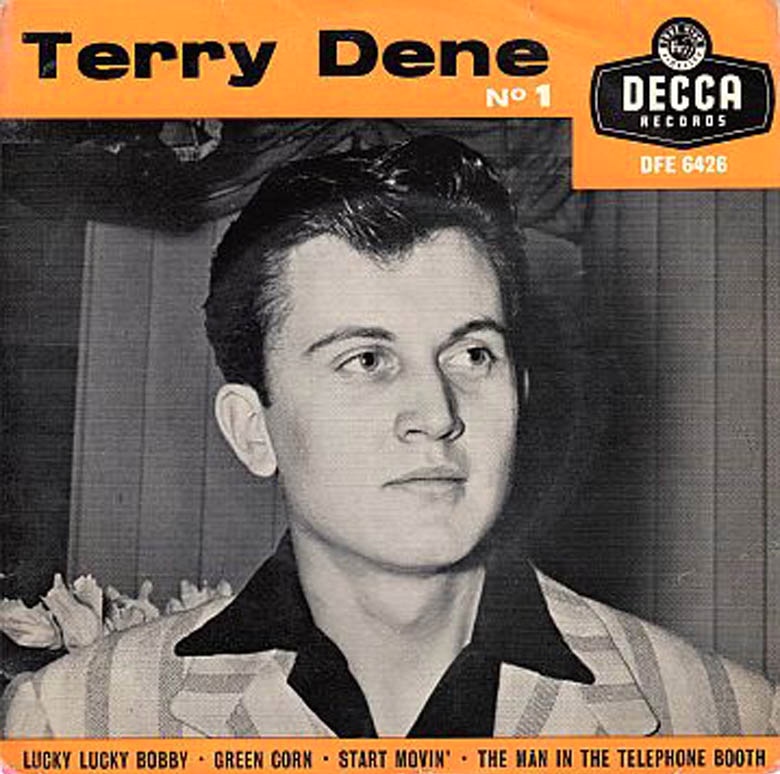
By the first week of June 1957, Dene’s first Decca single A White Sport Coat (And A Pink Carnation) was at No.18 in UK Top 20. As sung by the versatile American country artist Marty Robbins, this was a song of major crossover appeal. In the pre-Billboard Hot 100 era, Robbins went to No.2 with it in the US pop charts.
In Britain, The King Brothers got their cover out ahead of Dene and went to No.6. That didn’t overly distress Terry. He hated the song so much that he refused to plug it in his shows, its sentimental nature being so contrary to his more raucous live image. But that didn’t stop Decca getting him back in to their studio to record more tame fare.
Start Movin’ (In My Direction), a Stateside hit for James Dean’s Rebel Without A Cause co-star Sal Mineo, reached No.15, and another Robbins number Stairway Of Love went to No.16. Again, neither song was liked by Dene.
Ballsy Beat Boy
Drummer Clem Cattini who, along with Gregg, eventually became a member of his road band The Dene Aces before becoming one of Parnes’ Beat Boys and then joining Johnny Kidd, expressed his sympathy. Interviewed by this writer in 2017, he said: “I didn’t like his records. He sang the wrong material. Terry was very different to Johnny Kidd as a vocalist. They were both great in their own ways. Johnny was a bluesy, ballsy rock’n’roll singer. Terry was more of an Elvis type. He used to do all the Presley stuff on stage and it was tremendous. I loved Terry. He was a nice guy. We bought a van and it had Terry Dene & The Dene Aces on the side and we thought, ‘This is great’. Until one night after the show we went out to get the van and it was absolutely wrecked. It had been vandalised by the Teds.”
In fact, tucked away on the B-side of his singles, Dene was occasionally allowed to show what he could do. A decent version of Jack Scott’s Baby, She’s Gone slipped onto the flipside of Lucky Lucky Bobby. An excellent dart at Pretty Little Pearly, originally sung by the Click-Clacks and subsequently recorded by Gene Vincent, was paired with Who, Baby Who.
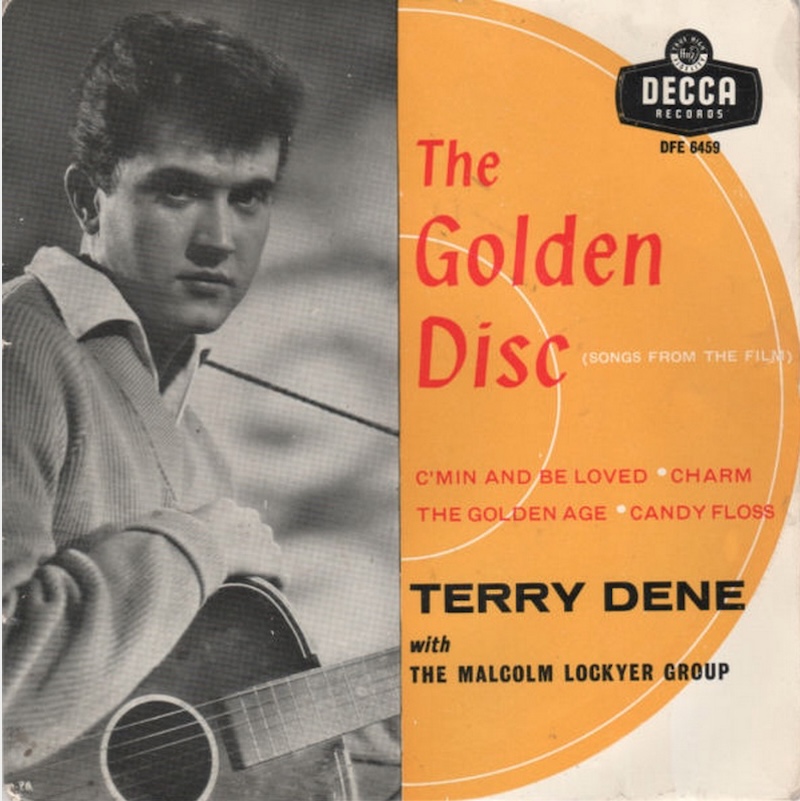
Also drawing a spirited vocal was a rare Dene original, the non-charting C’min And Be Loved from the movie The Golden Disc (1958). With his dreamy good looks, Dene starred in this Don Sharp-directed musical which, with a loosely biographical plotline that tracked Terry’s rise to fame, vainly sought to repeat the Top 10 box office success of The Tommy Steele Story. But although the New Musical Express praised Dene’s “convincing acting”, the film flopped and was, as Pete Frame put it in The Restless Generation “a terminal embarrassment to all concerned.”
Bad Reputation
By then, Dene had acquired a reputation. In the summer of 1957, billed as “Decca’s sensational Terry Dene” he’d been part of a combined rock’n’roll and skiffle Rock Across The Channel package show to France, along with Chas McDevitt’s Skiffle Group, Wee Willie Harris (then going by the stage name of Steve Murray), Leon Bell and Rory Blackwell. Apparently, Dene was supposed to serenade their hosts with a rendition of La Marseillaise but as the wartime steamer the SS Royal Daffodil pulled into the Calais docks, he was too drunk to perform.
At the start of 1958, the dailies were reporting that Dene had been caught walking round London’s West End in a state of inebriation and undress, smashing shop windows. He was fined for drunk and disorderly behaviour. Another fine was dished out by a magistrate in Gloucester for similar behaviour while on tour there.
It was a tempestuous love affair, conducted in the public eye, with the singer Edna Savage that was said to have sparked Dene’s increasingly unpredictable behaviour. They finally married in June 1958, but at this point Dene embarked on National Service. At the barracks he was jeered by fellow conscripts, jealous of his success and mocking his marriage. This and a letter from Edna telling him she was having an affair was enough to spark the sensitive Dene’s mental collapse. He was transferred to a psychiatric hospital and ultimately discharged from the army.
Predictably, the national press had a field day, Dene becoming the vehicle through which they could channel the hatred – and even fear – that many felt about rock’n’roll. Questions were even raised in Parliament about Dene’s behaviour.
Out Of Control
Back on civvy street, Dene, working with both Cattini and Gregg in a reformed Dene Aces, tried to stabilise a tottering music career. But while he still drew screams from females, he had become the object of derision from posturing males. Dene’s behaviour spiralled out of control once more, and even his management and friends including Gregg and Cattini lost patience with him.
There would be a brief spell as a member of the Larry Parnes stable of stars, but too much ground had been lost. Dene was now down the bill, below the likes of Billy Fury and Dickie Pride.
After his contract with Decca ended in 1959, he had a spell on Oriole. In 1961, Brian Gregg came to his aid once more and got him a short-lived job singing with Rhett Stoller’s band, just after they’d had a hit with the instrumental Chariot.
Eventually finding solace in Christianity, Dene recorded gospel albums in Sweden, where he still had a strong following. In later years he returned to the stage at rock festivals periodically to demonstrate what a loss he’d been to the UK scene. In 2024 an interview was aired on Talking Pictures TV in which he chatted to Lola Lamour about his career and sung and played guitar. Despite the sneerers and detractors, there was always a lot of love for Terry Dene.
Rock’n’Roll Rollercoaster
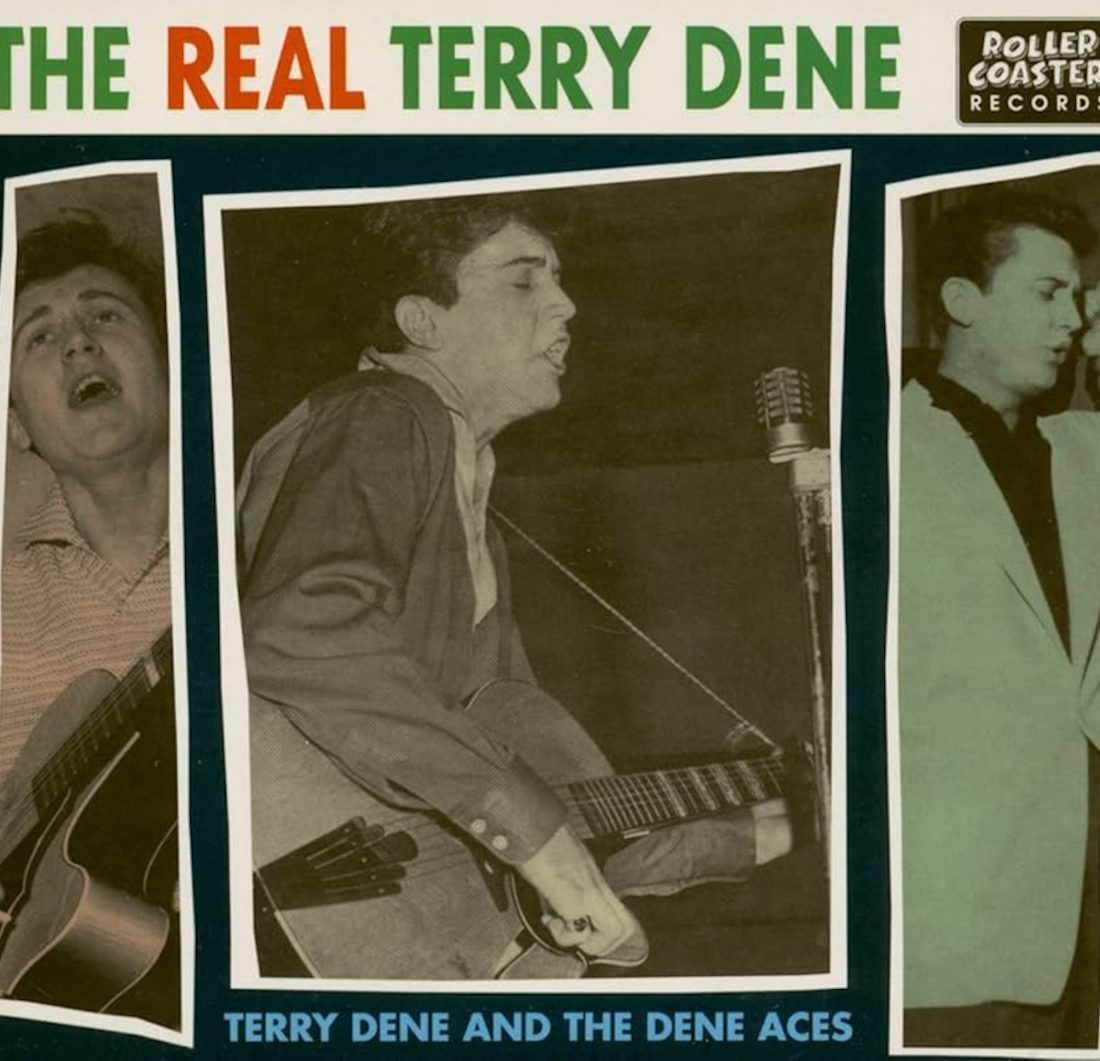
Listening to his Decca singles, it’s difficult to get a handle on Terry Dene the 1950s teen rocker. Required to sing mushy material, his voice was hemmed in by gales of backing choruses and overwrought arrangements. But The Real Terry Dene, released by Rollercoaster Records in 1997 and still available, fills in some missing parts.
It has a 16-page booklet with notes by his great friend Brian Gregg, who sadly died in April 2024, aged 85. Gregg opines that: “If Terry Dene had had the luck he deserved, he would be where Cliff Richard is today!”
The 27-track disc includes several of the demos Dene and Gregg recorded in HMV’s tiny recording studio in 1956, including Baby She’s Gone, That’s All Right, Good Rockin’ Tonight, Lock And Chain and Mystery Train. But the cuts from much later live appearances showcase Dene as a mature, confident rocker. There’s an over-reliance on Elvis material and the lead guitar is a bit in-your-face, but it’s quite a revelation.
Alternatively, Jasmine’s Like A Baby – The Complete Early Terry Dene 1957-1962 is an excellent overview of his commercial career.
Subscribe to Vintage Rock here