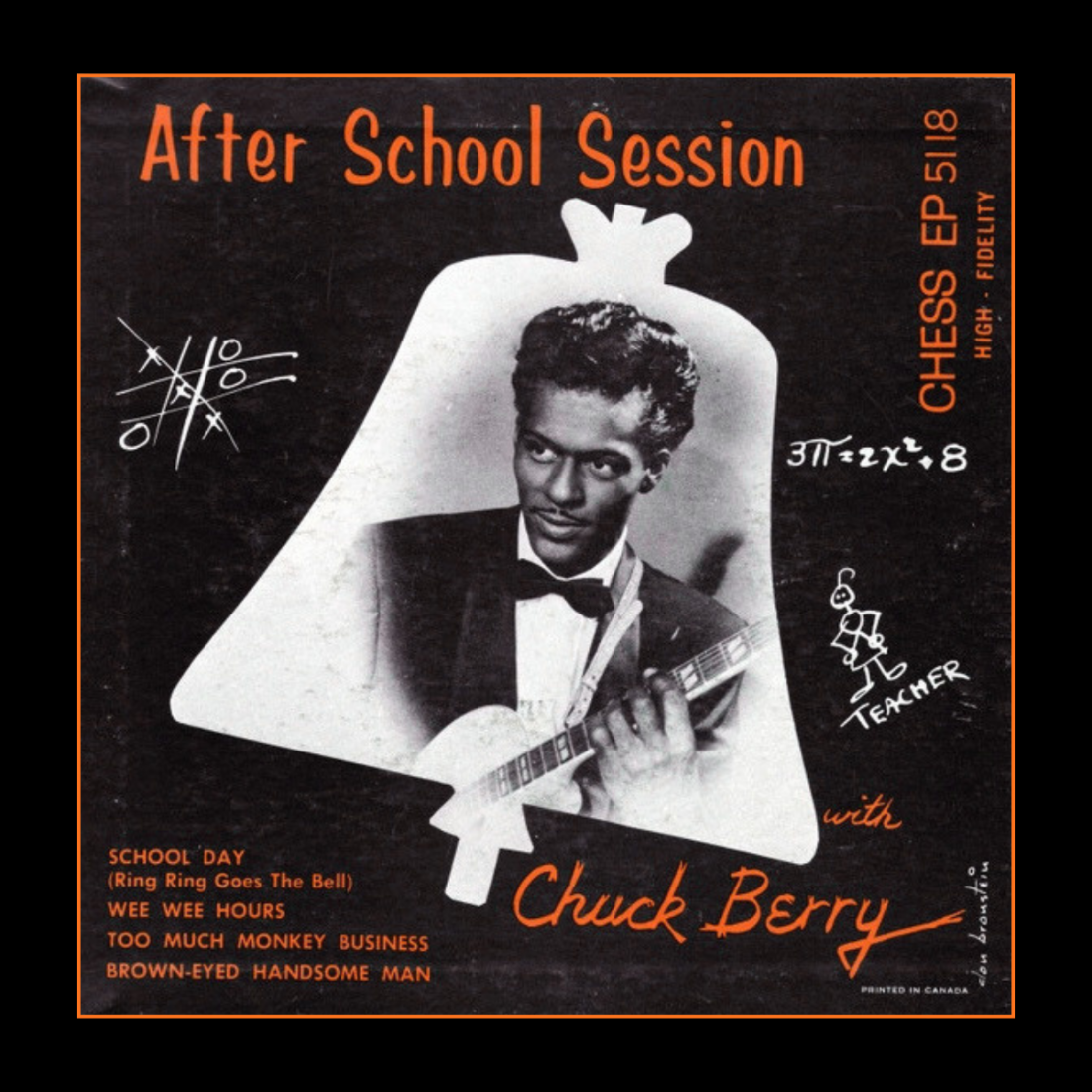
Although he was one of the prime architects of rock’n’roll, even architects need plans and bricks to see their dreams fulfilled – here we explore the roots of Chuck Berry.
Although his music arrived like a big bang, it didn’t come out of nowhere. Chuck Berry was singing with a church choir at the family home – on Goode Street (note the spelling), The Ville, St Louis – from the age of six, had a keen ear for all manner of different music, and after taking up guitar made sure he had lessons. He learned photography from his uncle, Harry Davis, a professional photographer, and was noted for having the latest Polaroid cameras. His early work in an automobile factory fed his taste for glamorous rides which helped fuel his pioneering lyrics…
Although Berry sometimes acted as if he’d “invented” rock’n’roll single-handedly, even he knew that wasn’t really true. While his own inimitable style and swagger made a massive impact, here are just a few of the major influences on the music and art of the late, great Chuck Berry…
Poetry & Motion
Berry is widely regarded as the genius lyricist of his generation, the first poet of rock’n’roll. Berry’s vocal lines barely relied on melody at all: he was all about meter, alliteration, clever wordplay and brilliant storytelling.
It’s probably fair to say that until Bob Dylan came along in the early60s, Berry was completely unrivalled as a “rock” lyricist. Music critics may say that Berry’s songs all sounded the same. Maybe they did, but who cares: every one of them was a different story, and brilliantly told. Berry not only invented his own words — “motorvatin’ over the hill” when he “saw Maybellene in a Coupe de Ville” — but he could also find the poetic in seemingly mundane life.
In You Never Can Tell’s tale of the “teenage wedding” couple’s start in life, he sings: “They furnished off an apartment with a two-room Roebuck sale/ The Coolerator was crammed with TV dinners and ginger ale”… Name-checking specific brands in a pop song as signifiers of wealth and status (or lack thereof) was unheard of at the time. It’s not even that common now. But it certainly resonated.
In Nadine, a seemingly simple tale of trying to win his girl back, Berry isn’t just calling after his woman, oh no. “I saw her from the corner when she turned and doubled back/ And started walkin’ toward a coffee coloured Cadillac/ I was pushin’ through the crowd to get to where she’s at/ And I was campaign shouting like a southern diplomat.”
“Campaign shouting like a southern diplomat”? That, aspiring wordsmiths, is genius. This evocative imagery didn’t go unnoticed by his followers. In Hail! Hail! Rock’n’Roll, Bruce Springsteen praises: “I’ve never seen a coffee-coloured Cadillac, but I know exactly what one looks like.”
Cars & Girls
Berry’s obsession with cars and cruising held-up a perfect mirror to teen dreams in 50s America. He undoubtedly knew what he was doing: in the USA in 1941, 29.5 million automobiles were registered, yet by 1950 it was 49.3 million. Berry’s words echoed teenage dramas like no one else, and he was certainly the first rock lyricist to be inspired by teen consumerism as well as teen romance, and it usually involved cars (or, for the less fortunate Lothario, a Greyhound bus).
His Route 66 certainly fitted the bill – covering another prime inspiration, Nat “King” Cole – but his own songs were even better. In You Never Can Tell, there’s a wonderful example of careful attention to a seemingly humdrum detail: “They had a souped-up jitney/ ’Twas a cherry red ’53.” (A “jitney”, if you didn’t know, is a “dollar van” used primarily in African American/Latino inner-cities.)
No Money Down is the blues expressed via motor-lust. Berry’s “motorvatin’” again, in search of upgrading to another Cadillac Couple de Ville (yellow, this time!) from his “broken-down, raggedy Ford”. “I want air condition/ I want automatic heat/ And I want a full Murphy bed/ In my back seat!” It was sheer poetry to the guys who needed the wheels to the get the girl.
If I Were from 1979 was from when Chuck’s musical mojo was all at sea, but lyrically he was still a hoot. It’s full of metaphors about the ordinary guy (Chuck) chasing after a girl who’s out of his league – and the last car-fixated verse is another Berry masterstroke of metaphor and innuendo:
“If you were a Mercedes-Benz/ I’d have to be a Fleetwood Brougham
“And ev’ry time I saw you rollin’ on the freeway/ I think I’d have to follow you home
“You could let me lodge in your double garage/ Bumper to bumper out of the weather
“Nobody home but the Benz and the Brougham/ Really rarin’ to roll off together.”
The Big Band Sound
Given his penchant for teen anthems at the dawn of rock’n’roll, Chuck Berry’s age wasn’t at first really noted. But he was a grand ol’ 29 when he hit with Maybellene, nine years older than Elvis, and his true tastes were actually somewhat different to many teen rock’n’rollers. Chuck loved big bands primarily, and he adored the smooth singing of Nat “King” Cole and Frank Sinatra, who he called “the greatest singers of all time”.
Berry once famously said, “Rock’n’roll accepted me and paid me… even though I loved the big bands, I went that way because I wanted a home of my own. I had a family. I had to raise them. Let’s don’t leave out the economics. No way.” Does that make Berry a rock’n’roll opportunist? You could look at it that way. In reality, he was just moving with the times. Anyway, he recorded enough blues, Latin, calypso and crooning tunes outside of his big rock’n’roll hits – they just didn’t get as much attention.
When promoting his book in 1987 on The Tonight Show, as the show’s theme music ended, Chuck exclaimed: “All I wanted to do was comp chords behind a big band!” Then he called out to bandleader Tommy Newsom, “Tommy, Tommy! Gimme a job! That was rock’n’roll, and that ain’t gone away.”
Hillbilly Hits & Country Classics
Berry may have started playing country and hillbilly as a light experiment, but he was genuinely a fan. Berry’s own songs often have a much more major key feel than the average blues, and many could essentially be country tunes. His songs also told stories, with more of a country-esque narrative than a trad blues. Playing hillbilly songs early on also meant Berry could crossover to white audiences, even if clubs that booked him sometimes even turned him away, because of his colour.
As well as turning Ida Red – a country tune made popular by Bob Wills and his Texas Playboys – into his own Maybellene, Berry was well aware of Hank Williams’ Move It On Over (1947) – a big influence on him, and many other notable rock’n’rollers, too. The breakthrough of rock’n’roll may have originally petrified the Nashville hierarchy in 1956, but Chuck didn’t really care for such supposed boundaries: the “Father of Country Music” Jimmie Rodgers was one of his favourite artists. “Chuck knew every [Rodgers] Blue Yodel, and most of Bill Monroe’s songs as well,” Carl Perkins remembered. In 1971, Berry cut Hank Williams’ Jambalaya as Bordeaux In My Pirough, truer to his Creole/Louisiana roots (and partly sung in French patois). Berry’s music really was a melting-pot of flavours.
It’s all just labels, really. But it used to be important as so many country stars were vocal in their loathing of rock’n’roll, and skin colour used to be such a demarcation between the two. In Arnold Shaw’s 1978 book Honkers And Shouters: The Golden Age Of Rhythm & Blues, blues singer Jimmy Witherspoon is quoted as saying, “Chuck Berry is a country singer. People put everybody in categories, black, white, this. Now, if Chuck Berry was white… he would be the top country star in the world.”
KEY FIGURES:
T-Bone Walker
T-Bone (Aaron Thibeaux) Walker was a guitar hero to Chuck, just like he was to BB King. Call It Stormy Monday (1947) was Walker’s most enduring hit (later covered by Bobby Bland and The Allman Brothers) and he was one of the first blues/jazz players to really put the guitar centre-stage. T-Bone was always dapper in smart suits, but was also a wild showman – playing guitar behind his head, doing the splits, and coaxing feedback from his guitar onstage.
Blues maestro and scholar Duke Robillard reckons: “A lot of the technique and the little T-Bone phrases that define his style, Chuck Berry, when he rearranged the beat, they became rock’n’roll guitar licks. So in essence, T-Bone was not only the first electric blues guitar player, but he was the first electric rock’n’roll guitar player, really.”
Charlie Christian
Charlie Christian is a pivotal figure for all guitar players of Berry’s era: along with Eddie Durham, Oscar Moore and George Barnes, he’s widely credited as being one of the first to record with the electric guitar, and is famous for his work with the Benny Goodman Orchestra from ’39 to ’41. Berry was more than just a passing admirer – when Berry took guitar lessons in The Ville from neighbourhood player Ira Harris, he asked to be taught some licks of Charlie Christian’s.
Johnnie Johnson
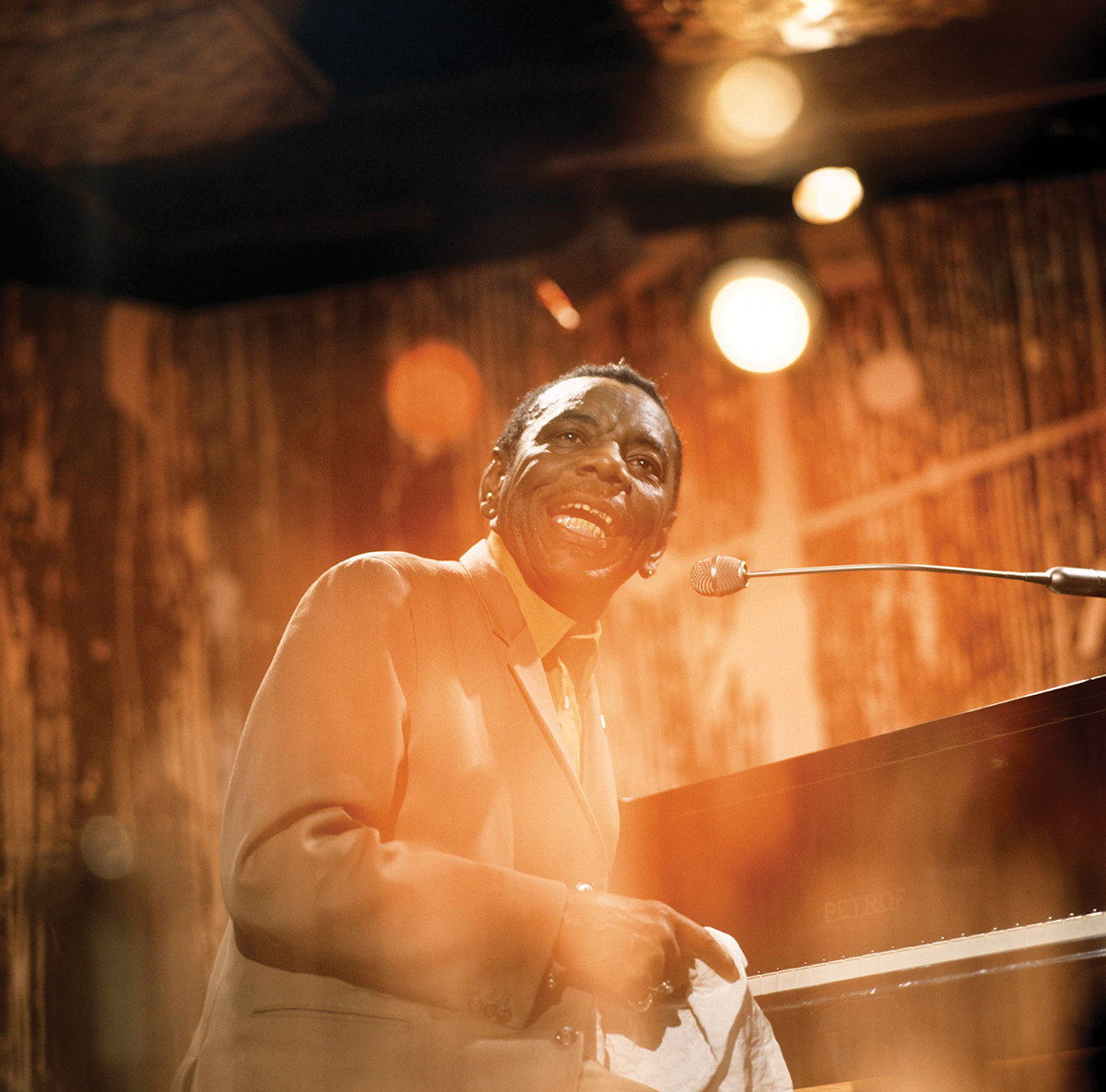
Johnnie Johnson is the unsung hero in Chuck Berry’s success. Johnson gave Berry his first paying gig with his Sir John Trio and kept him on. As the Trio developed, Berry was very much “the piano player’s guitarist”… until the hard-hustling Chuck took over band control. A lot of Berry’s songs, as Keith Richard and many others have noted, were in guitar-unfriendly keys such as B flat or E flat. It didn’t take a leap of logic to guess that many of these boogie tunes had maybe come from the fingers of Johnnie Johnson. Example? The Berry-credited Wee Wee Hours [the B-side to Maybellene] was a simmering blues tune Johnson had playing for years.
Carl Hogan (with Louis Jordan)
A particularly strong influence on Berry was Louis Jordan’s guitarist Carl Hogan and his primitively rockin’ rhythm style in Louis Jordan’s Tympany Five. “He stuck to the I-IV-V, played mainly quarters and eights, and played right on the beat,” Berry told Tom Wheeler in Guitar Player magazine. Berry covered the Tympany Five’s proto rock’n’roller of 1946 Ain’t That Just Like A Woman on his 1965 album Fresh Berry’s, and it’s killer.
Muddy Waters
As the leading figure in electric Chicago blues, Waters was an influence on every aspiring blues/R&B songwriter and guitar player of the early 50s, but he was a key figure in Berry’s career, as Chuck went to him for specific advice. When Berry travelled to Chicago in May 1955 and scraped together 50 cents to see Waters play, he got to meet him but didn’t waste time fawning over one of his idols. “I listened to him for his entire set,” Berry recalled. “When he was over, I went up to him, I asked him for his autograph and told him that I played guitar: ‘How do you get in touch with a record company?’ He said, ‘Why don’t you go see Leonard Chess over on 47th?’” That information would change Chuck’s life – and rock’n’roll as we know it.
Leonard Chess
It’s typical of the record industry both then and now for artists to be “steered” by their label owners. Chuck Berry was no different. When Berry first went to see Leonard Chess at Chess Records, Berry was pretty sure his bluesy Wee Wee Hours would be the song to impress at the home of Muddy Waters, Howlin’ Wolf and songwriting supremo Willie Dixon. But Leonard Chess could see the blues/R&B market faltering, and it was he who picked Berry’s cover of Ida Red instead. Berry had slightly rewritten the song and called it Ira Mae, but Chess didn’t like that title either: “too rural”, apparently. And he didn’t wanted any copyright hassle. He also told Berry to rewrite some lyrics: “the kids want the big beat, cars and young love.”
But what should they call the new song? “Nobody could think of a name,” Johnnie Johnson recalled later. “We looked up on the windowsill, and there was a mascara box up there with ‘Maybelline’ written on it. And Leonard Chess said, ‘Why don’t we name the damn thing Maybelline?’” Chess made the spelling change, too. Repeat: he didn’t want copyright hassle, especially not from a huge cosmetics company.
All of this was no problem for Berry, who cared more that the beat of the song remain intact. He later explained: “Maybellene has the same rhythm as Ida Red, like dah-di-dah, you know… So [the] rhythm I had, but I had somebody else’s title, you know. So that’s how Maybellene came up.”
Leonard’s son, Marshall Chess, went on to become Chuck’s tour manager. Marshall Chess told Sabotage Times of a meeting with Berry years later, where Marshall was telling Chuck how he’d revolutionised the fortunes of Chess Records. “Chuck said, ‘It wasn’t one-way traffic, Marshall. You guys made my life great. I couldn’t have gone anywhere without Chess Records.’ That was an emotional meeting for me. I think it was emotional for Chuck too.”
If Berry had gone to anyone else but Leonard Chess on Muddy Waters’ say-so, things could have turned out a whole lot different…
Words by Michael Stephens
For more Chuck Berry click here
Read More – Story Behind The Song: Chuck Berry’s Johnny B. Goode