Screamin’ Jay Hawkins was the godfather of ghoul rock, but did his wild image hold him back? Vintage Rock examines his extraordinary talent…
The rock act trading in theatrical gore has a long tradition, from the pantomime of Screaming Lord Sutch and the psychedelia of Arthur Brown, to the harder rock of Alice Cooper, Black Sabbath and Kiss. But arguably none of them had an ounce of the talent of their spiritual godfather, a very strange man from Cleveland, Ohio, born Jalacy J Hawkins, who really wanted to be an opera singer.
Screamin’ Jay Hawkins, as he became known, is often listed as a one-hit wonder. Technically, he wasn’t even that. I Put A Spell On You was considered so disturbing on release in 1956, with its animalistic grunts and suggestions of cannibalism, that many radio programmers denied it airtime. It may have accumulated an estimated one million in sales over the years, but it never charted for the singer, with later versions by Nina Simone, Alan Price and Creedence Clearwater Revival enjoying more success.
Macabre Magic
And so, despite being a favourite of the Alan Freed rock’n’roll revues for a time, Hawkins had an in-and-out career, spasmodically recording, and playing in small clubs with pick-up bands, in between brief bouts of renewed exposure, with highlights like opening for The Rolling Stones in Madison Square Garden, New York in 1981, or touring Australia with Nick Cave in 1985.
This was less than he deserved. To interviewers across his career, he conveyed a sense of frustration that his singular talent never received its dues, and that he was treated as a gimmick who arrived on stage in a coffin and used ghoulish props, rather than a singer with a vocal range seldom heard in popular music. “If it were up to me I wouldn’t be Screamin’ Jay Hawkins,” he complained in 1973.
“My screamin’ was always just my way of being happy on stage. James Brown, he did an awful lot of screamin’, but he never became Screamin’ James Brown! I’ve got a voice. Why can’t people take me as a regular singer, without makin’ a bogeyman out of me?”
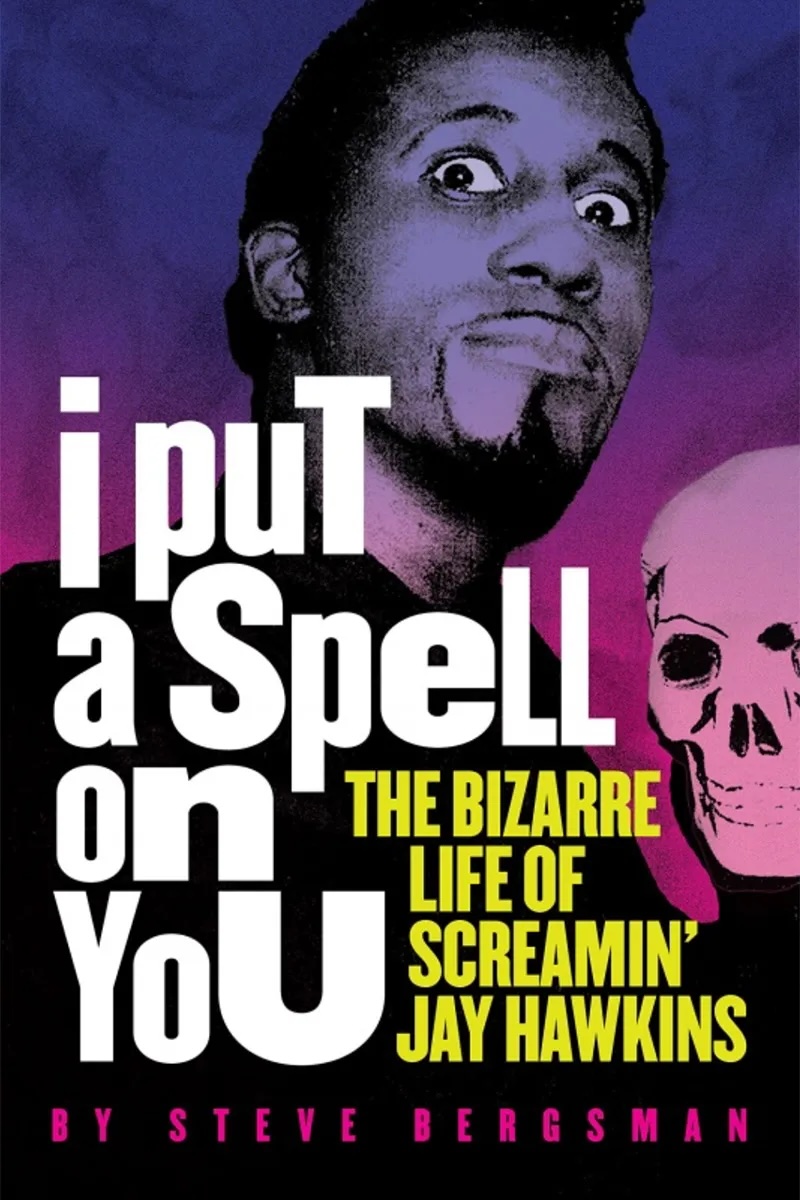
However, as Steve Bergsman’s biography I Put A Spell On You: The Bizarre Life Of Screamin’ Jay Hawkins underlines, the artist was complicit in the creation of his image. Bergsman has conducted interviews with Hawkins’ family, former bandmates and other associates, without managing to uncover the enigma of this essentially unknowable, contradictory figure. All the same, it’s a riveting read.
Primeval Power
Hawkins cut his musical teeth in the Cleveland jazz club scene of the early 50s, working with Tiny Grimes, whose small combo, The Rocking Highlanders, played an edgier kind of jazz and blues, typified by uptempo numbers like Juicy Fruit, Coronation Jump, on which Hawkins played piano, and a reworking of the traditional Scottish tune Loch Lomond. The musicality of his time with Grimes seldom left Hawkins. The visual eccentricity of The Rocking Highlanders, who skipped about the stage in kilts and tam o’ shanters, suited him too. Always flamboyant, when he followed up with a stint as Fats Domino’s warm-up act, he got sacked for stealing the show by wearing a gold-encrusted leopard skin outfit, topped off with a turban.
Bergsman suggests it was more likely a clash of egos between two ambitious young performers that led to the parting of their ways. Listening to some of Hawkins’ earliest vocal recordings from 1953 onwards, it’s plain that a voice like that wasn’t going to play second to anyone for long. It’s been suggested that the closest model for the Hawkins sound was the blues shouter Wynonie Harris, who had got him his first club job in New York City in 1952. Bergsman thinks he may also have been listening to Amos Milburn who specialised in drinking songs, and Stick McGhee, who’d had a hit with Drinkin’ Wine, Spo-Dee-O-Dee in 1949.
The reality is that, whereas all those artists now sound stylised in the way of the time, Hawkins’ recordings for the Timely, Mercury and Wing labels have an extra dimension of danger, and a sense of the theatrical that transcends the work of almost every other R&B singer of that period. In any other hands, Not Any More would have been a predictable, plodding blues number, but Hawkins’ agonised wailing, backed by Red Prysock’s booming sax, has an unearthly quality. Hawkins’ closure of that song was like an anguished roar from the depths, raising the hair on the back of your neck long before he started messing about with coffins. The hall-like acoustic only adds to the eerie, almost primeval power.
Spellbinding Star
Other unmissable early recordings include Baptize Me In Wine, This Is All, and (She Put The) Wamee (On Me). The latter track included maniacal screeches, threats of violence in lines like “I’ll blow the moonlight clean through your bald head,” and moans about the evil eye. It helped that he was being backed by stellar players like Mickey Baker (guitar), and Panama Francis (drums), as well as saxophonists like Prysock, Sam “The Man” Taylor and Big Al Sears, but Hawkins’s vocal panache and unusual phrasing transcended genre singing. As British music writer Bill Millar wrote, these recordings are “dark, sere, seemingly inebriant performances with few equals in blues or rock.”
In 1956, Hawkins’ promise was such that he was signed by Columbia’s R&B specialising imprint OKeh, going into the studio in September to cut a new version of a self-penned song that would change his life. He’d already recorded one version of I Put A Spell On You as a tender ballad, written in a melancholy state after a girlfriend jilted him, for a Philadelphia label, Grand. How the historic version came to be made is one of those Hawkins tales for which there are alternate accounts. However, it seems that Columbia A&R man Arnold Maxin, who helmed the session, was searching for a way to make the song darker and edgier.
At the session were many of the musicians who’d backed Hawkins on his earlier recordings, like Taylor, Sears, Baker and the skilful arranger and musical all-rounder Leroy Kirkland. It seems Maxin, in an attempt to loosen up the atmosphere, sent out for a large order of chicken and barbecue ribs, along with a wagon load of hooch. It clearly worked. Hawkins claimed he sang parts of the song lying flat on his back, while Baker was also completely drunk. Taylor had trouble getting his lips round the mouthpiece of his sax.
All of these musicians were well used to playing under the influence, so it’s not difficult to imagine how they were still able to cut a good record. What’s curious about the song is the contrast between the comedic banjo strumming and the gentle waltz-time rhythm, and the threatening air created by Hawkins’ ominous voice and the saxophones. Bill Millar has written that the menacing background figure was derived from an early 19th century opera La Juive.
Underground Success
Maxin knew the new version of I Put A Spell On You was just the thing to grab the ears of an ever-growing teenage radio listening and record buying public. The trouble was that Middle America, already troubled by Elvis Presley and Little Richard, hated it. A morality backlash followed the single’s release, with complaints that it was demented and too erotic for youngsters. Even the African-American civil rights body the NAACP would claim Hawkins was “demeaning the coloured man.” So a cleaned-up version, which excised the closing sequence of grunts and snorts, was released. It made no difference. Unofficially, the record, which had on its flipside a nifty little R&B shuffler with another whacky lyric and vocal, Little Demon, sold well. But, mysteriously, it never registered on any charts.
The underground success of Spell… made Hawkins a prisoner of his image. As he told Nick Tosches, “Man, it was weird. I was forced to live the life of a monster. I’d do my act… and there’d be all these goddam mothers walking the street with picket signs: We don’t want our daughters to look at Screamin’ Jay Hawkins.” Alan Freed saw the possibilities, however, and brought him into his rock’n’roll revues.
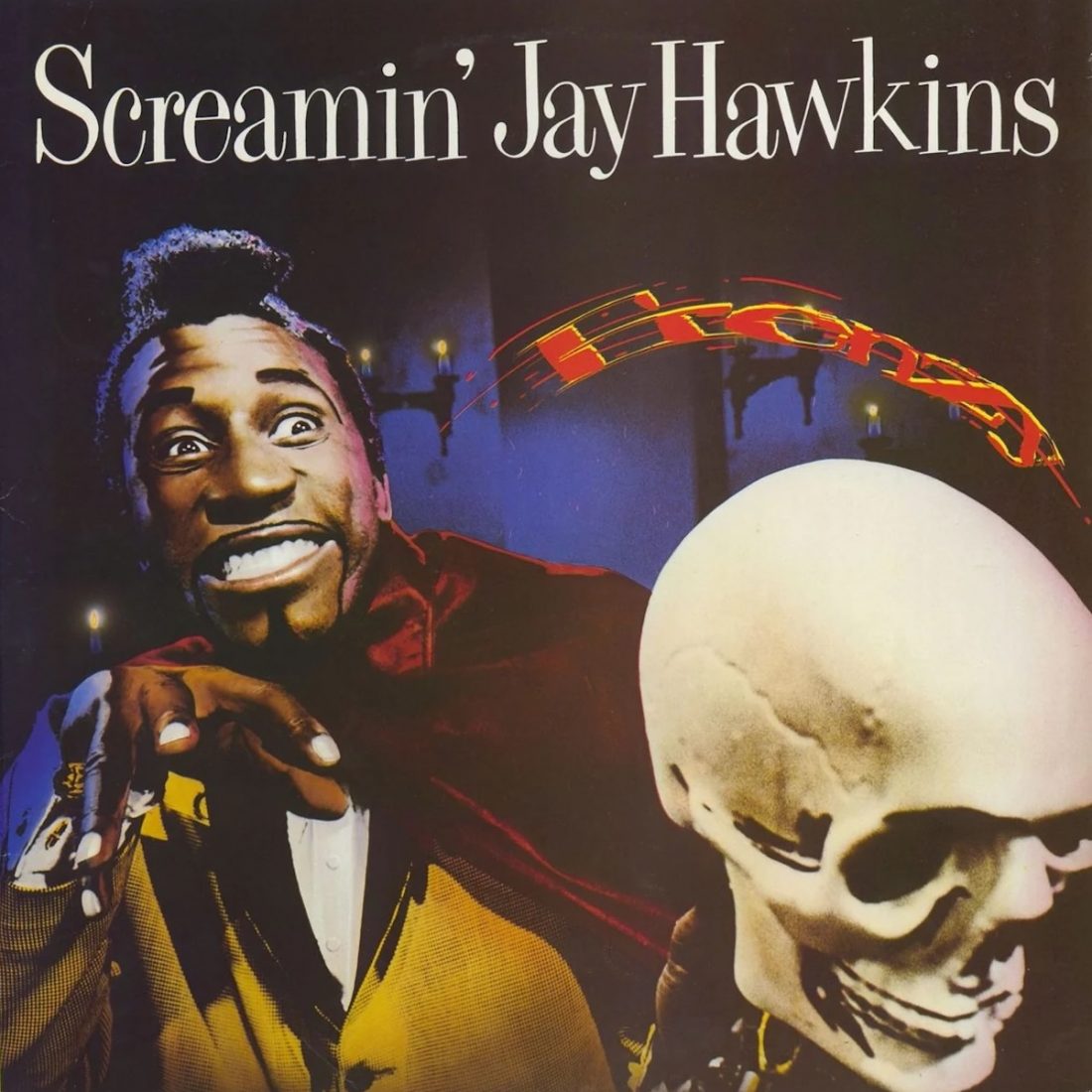
It was the DJ who came up with the coffin routine, to which Hawkins only consented when Freed sat in front of him and plied him with money. “Them $100 dollar bills got heavy and thick and looked good y’know…” recalled the singer. “Finally, he hit two grand. I told him, I’ll do it, I’ll try it.” Genuinely creepy when done right, the casket containing Hawkins would be carried on stage, after which the lid slowly opened as Hawkins’ gloved hand crept over the side. Then, as he rose, he’d glare at his young audience, rolling his eyes. He carried a gonk called Mr Gooch, later replaced by a skull, and a stick with a bell on it, which he’d shake demonically at the crowd. The National Casket Company was so troubled it sent a letter to morticians urging them not to lend, rent or sell a coffin to him.
Shock Rock
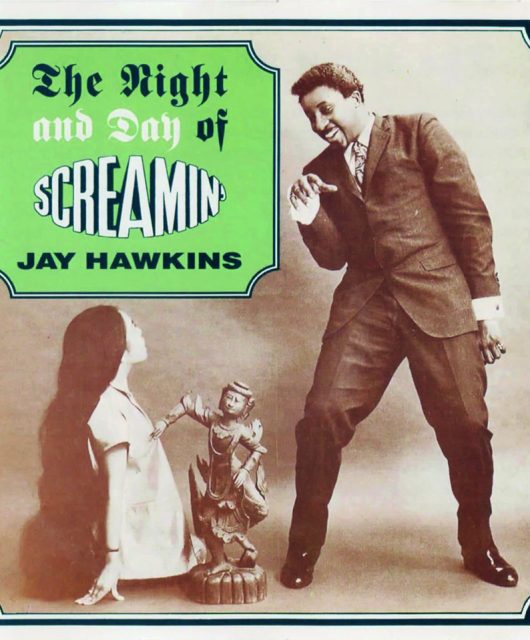
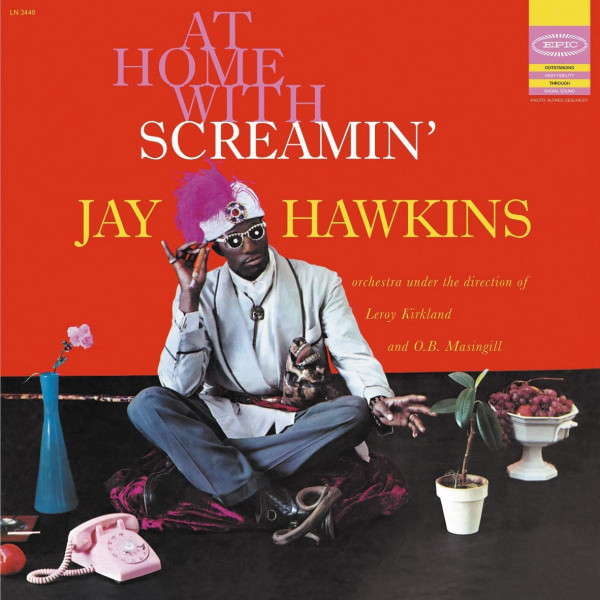
But the gimmickry overwhelmed the music. Hawkins’ name was soon dropping down the billing. When he played on Freed’s Big Beat tour of 1957, also on it was Jerry Lee Lewis. The latter liked Hawkins, but considered him more of a vaudeville act than a musical competitor. Yet Hawkins made good records, especially an album, At Home With Screamin’ Jay Hawkins, released on the back of I Put A Spell On You, which was among the 12 tracks. The LP was proof that Hawkins was too good to be pigeonholed.
Apart from Spell, the nuttiest track on the album was another Hawkins original, Hong Kong. Interspersed with fine, straight readings of ballads like If You Are But A Dream, there were entertaining reworkings of oldies like Gene Autry’s Give Me My Boots And Saddle, the cowboy star’s wistful falsetto ditched for anarchic grunts. The track that captures the schizoid Hawkins persona best is I Love Paris. After a white vocal group delivers the first verse, Hawkins comes swinging along in classic crooner style, before breaking offto do some crazy, now politically incorrect, impersonations of stereotypical German, Chinese and French accents.
Then he uses his magnificent, grainy baritone to deliver a straight finish as stirring as anything the likes of Ella Fitzgerald or Frank Sinatra ever managed. He’d do this time and again across his career, notably when singing Jesse Belvin’s 1956 R&B hit Goodnight My Love for his 1970 Philips album Because Is In Your Mind, finding depths of feeling beyond most artists.
Cult Icon
Even as his career seemed to fall away, Hawkins was capable of great moments on record. One of his most overlooked records is I Hear Voices, backed with another killer R&B shuffle I Just Don’t Care, a single he made for the Enrica label in 1962. The top side, with its ghostly screams and whispers, was Hawkins at his demented, paranoid best, real call-the-menin- the-white-coats fare.
But it would be mid-1960s Britain that gave his career a lift. By this time, he was singing, playing piano and doing general MC duties at a club in downtown Honolulu, his commercial career seemingly as good as done. His comeback owed much to the enthusiasm of a group of British R&B enthusiasts. Together with a jazz-loving American couple, who’d caught Hawkins’ act while on holiday in Hawaii and been moved by the spectacle of a former star plying his trade in a tourist joint, they helped engineer a profile-raising, first ever UK tour in 1965.
Musical Legacy
Significantly, several of these British fans would be key to ensuring the proper recognition of Hawkins’ work in the years ahead. Among these were the distinguished rock and R&B writers Cliff White and Bill Millar, the latter writing extensive notes for what are still the most important, two-disc, compilations of the performer’s recordings, on Bear Family Records, Spellbound! 1955-1974 and Screamin’ Jay Rocks. Similarly, Mancunian photographer Brian Smith’s carefully framed images of Hawkins, both in performance and when relaxing or goofing about off-stage, offer us the best visual record of this charismatic figure.
After tours of the UK in 1965 and 1966, Hawkins’ career would receive a further boost when Creedence Clearwater Revival had a hit with their revival of I Put Spell On You. He’d go on to work with Keith Richards, and even got a British chart entry with a recording of Tom Waits’ Heart Attack And Vine, which made No.42 on the UK pop chart in 1993.
He’d appear in movies, and was on one of his career ups when he died in 2000, aged 70, though sadly, as Bergsman’s book reveals, his always tempestuous private life had turned pitiful by the end. Fortunately, though he once said, “I think you have to see me to appreciate me,” Hawkins left a recorded musical legacy that is still thrilling us today.
I Put a Spell On You The Bizarre Life of Screamin’ Jay Hawkins by Steve Bergsman, is published by Feral House
Subscribe to Vintage Rock here