Although mainstream recognition only came with a run of countrypolitan ballads in his ‘Silver Fox’ phase in the mid-1970s, Charlie Rich was a widely respected artist and one of Sun’s last hitmakers…
You might say how appropriate it was that Charlie Rich, after years of underachieving, had his biggest moments on the Epic label, because an epic talent is exactly what he was. But that would be too grandiose a claim for such a reserved, unassuming man. It’s also stretching it describe him as a rock’n’roll hero, because his heart was never totally in the Big Beat.
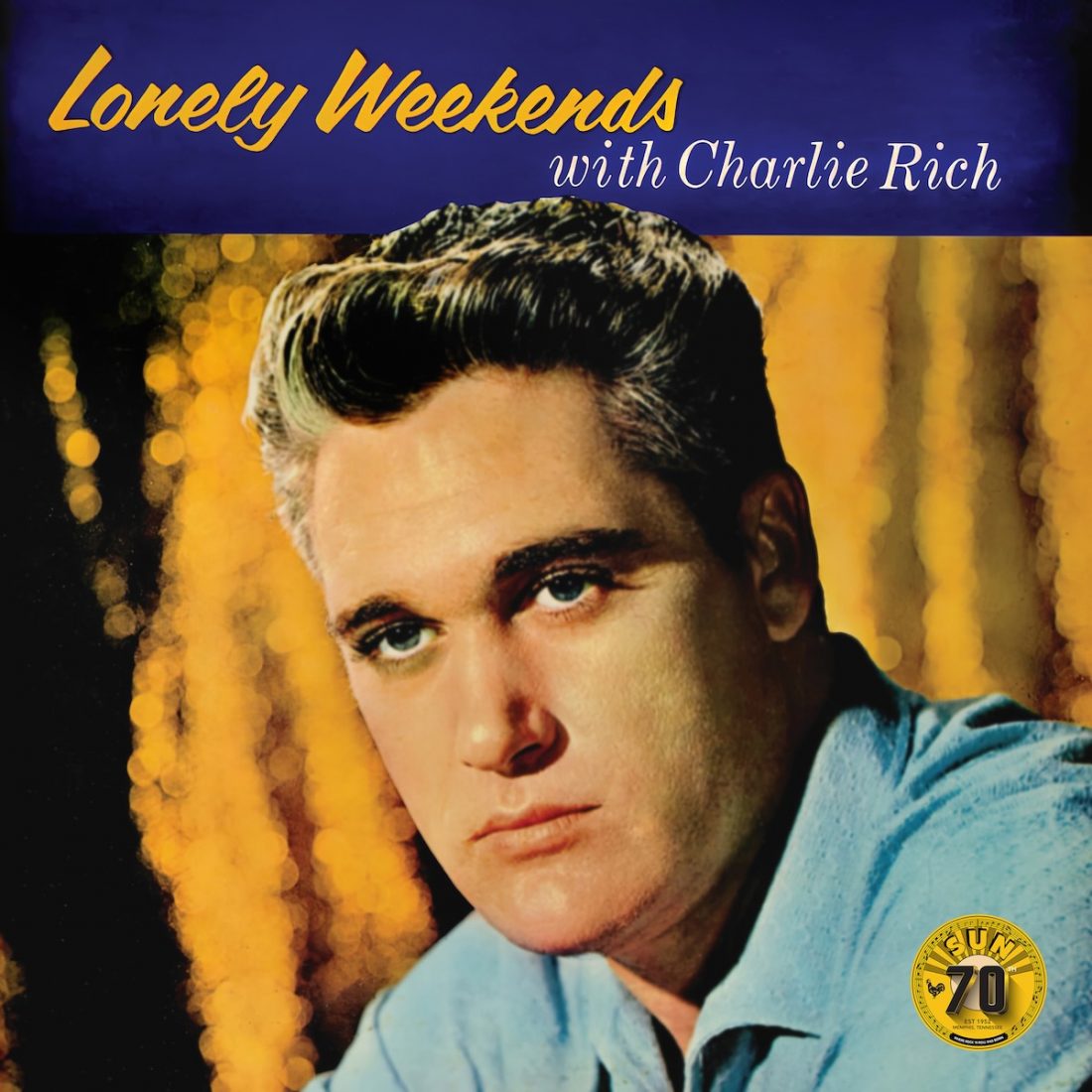
On the other hand, Sam Phillips reckoned he’d never worked with a more talented writer, singer or musician. Rich’s Lonely Weekends was one of Sun Records’ final hits. While he was with the label, he also wrote songs for the likes of Jerry Lee Lewis, Johnny Cash, Ray Smith and Carl Mann. Any early hopes that he might be another Elvis were doomed to fail, but he is an integral part of the Sun story.
In later years, publicists dubbed Rich the Silver Fox, but he could just as easily have been the Gentle Giant or the Big Bear. He was a tall, brawny guy, with the shoulders of an American quarterback. In fact, the Arkansas-born artist was set for a football scholarship at the local state college at one point, before switching to a, similarly aborted, music major at the University of Arkansas.
His thickset build and some premature streaks of grey gave him a distinguished maturity that was of a different order to pretty boy Elvis Presley. Barbara Pittman, one of Sun’s rare female rockers, told Hank Davis for the 44-page booklet that accompanies Bear Family Records’ 3-CD Charlie Rich: Lonely Weekends, The Sun Years 1958-1962, “He was one of the best-looking men I’d ever seen. Oh my God! Elvis was pretty, but Charlie was handsome.”
Not So Flash
Early publicity photos caught a smouldering ‘Elvis look’ in the eyes, beneath an impressively thick, swept back mane. Allied to tonal similarities, for a time the gullible mistook him for the Mississippi Flash. But Rich was anything but flash. He detested the limelight, preferring to write and do laidback studio demos.
When it came to live performance, an intimate club suited him better than a large gathering. That caused issues early on, such as when he was booked to appear on Dick Clark’s show, and later when the likes of Behind Closed Doors and The Most Beautiful Girl caused his profile to rocket in the 1970s. Hank Davis wrote, “He was a press agent’s dream, and a promoter’s nightmare.”
Despite what seems to have been near-universal liking for him among his professional colleagues, and admiration for his work from enlightened critics, Rich has always presented an assessment challenge because he drew on so many styles.
His biggest records were recorded in Nashville and had a sheen that was labelled as countrypolitan. But although in interviews he claimed to have listened to the Grand Ole Opry and country veterans like Roy Acuff and Ernest Tubb, he was not a hardcore country singer. Rich was more in spirit with the Black blues and gospel of Memphis than the white country of Nashville, but he wasn’t a straight blues or gospel singer either. Attempts to get on the upbeat end of the soul train in the 60s sounded overwrought. His true love was jazz, but he struggled to find a sustainable outlet.
Mr Nice Guy
During the Sun years, the requirement was to record and perform rock’n’roll. That didn’t suit him either. James ‘J.M.’ Van Eaton, who played drums on many of his Sun sessions, adored working with Rich, relieved to find him the temperamental opposite of the exhausting Jerry Lee Lewis.
“He was a big man who looked like he could take care of himself. But he was shy in front of an audience,” Van Eaton once told this writer. “People expected him to be another Jerry Lee, and he wasn’t. He’d just sit down and play these nice chords on piano.” Van Eaton reckoned he was a Frank Sinatra wannabe. At his worst, on some of his later records, this could descend into self-indulgent, after-hours noodling. But it’s fair to suggest that, of all the tracks on the Lonely Weekends boxset, it’s the ones which have a gently swinging, supper club vibe, the voice and piano to the fore, on which this sensitive, troubled man sounds most in his comfort zone.
In fact, Rich and Margaret Ann, his long-suffering wife, sometime promoter and frequent life-support mechanism, partly came together through a shared love of jazz. Rich’s favourite records were those of the extremely noisy Stan Kenton orchestra. Margaret Ann, who sang herself, favoured Anita O’Day and June Christy, two of the finest female jazz vocalists of all time, who sung in the Kenton band in different periods.
It was Margaret Ann, the pushier of the pair, who got her husband through the door at Sun in 1957. At first, he was deployed as a songwriter, because his musicianship was too sophisticated for the earthier fare Sam Phillips’ label traded in. But he proved well able to tailor his writing to provide suitable material for several of the label’s artists, and often also played piano on the sessions.
Cashing In
Ray Smith sang Right Behind You, Baby, (later also recorded by Vince Taylor & His Playboys), So Young, Why, Why, Why and You Made A Hit. Break-Up was recorded by Jerry Lee Lewis (and also by Ray Smith, as well as Rich himself), who also recorded the Rich-penned, I’ll Make It All Up To You and It Hurt Me So. Johnny Cash recorded The Ways Of A Woman In Love, co-written with Bill Justis. I’m Comin’ Home was a Carl Mann B-side (and subsequently appeared on one of Elvis’ early post-Army service albums, Something For Everybody.
When Cash departed for Columbia in 1958, an opening arose for Rich to cut singles in his own right. Released on Phillips International, the first two were the bouncing rockers Whirlwind and Rebound, Rich’s voice sounding faintly Presley-esque, the piano in the pumping boogie style of Lewis. But they only sold modestly, and it would not be until 1960 that he emerged with a third single and his first hit.
Lonely Weekends was an amalgam, as one of the last recordings to be done at the old Sun studio on Union Avenue in 1959, with a further overdub session a couple of weeks later at the company’s new studio at 639 Madison Avenue. Van Eaton recalled that the big double-timed bass drum pattern he played on the track was sourced from Big Man, which had been on the flipside of Rebound. Reaching a peak position of No.22 on the Billboard Hot 100 in 1960, Lonely Weekends appeared to be Rich’s breakthrough disc. But Phillips followed up with a too obvious attempt at replicating the song’s unusual sound, Gonna Be Waitin’, and the moment was gone.
Rockin’ On
The hardest rocker Rich ever cut at Sun was Break-Up, which was included on the Sun album Lonely Weekends With Charlie Rich (1960). This had originally been paired with another Rich composition I’ll Make It All Up To You on a Jerry Lee Lewis single in 1958, but its sales were hit by the underage marriage headlines that were enveloping the Killer’s career at this time.
Among the more R&B flavoured material he cut at Sun were his own compositions Midnite Bluesand Easy Money, as well as a trio of excursions into the world of Chuck Willis, It’s Too Late, C.C. Rider and Juanita. The classiest Rich song ever released in the single format during his Sun period was the ballad Who Will The Next Fool Be, a smoky country-blues mixture also later superbly subsequently interpreted by Bobby Bland and Jerry Lee Lewis.
Rich’s stabs at recording for the teen market, such as Donna Lee, Popcorn Polly and Deep Freeze, can be heard on the Bear box set. But he was always an artist for grown-ups. Away from the juvenile fare, the engaging jazzy instrumental Red Man was issued as a Sun single under the name Bobby Sheridan. The nostalgic School Days and a tender revival of Apple Blossom Time were not the choices of a singer out to sell to the kids. Neither were the two standout tracks on Lonely Weekends With Charlie Rich: Come Back and That’s How Much I Love You. Even more moving were the unissued, melancholic ballads, I’ve Lost My Heart To You and the torchy How Blue Can You Be. As Sam Phillips liked to say, no one got more feeling out of a song than Charlie Rich.
Read More: The Vintage Rock Top 101 Rockabilly Tracks