The singer’s charismatic Louisiana Hayride appearances were enthusiastically appreciated by screaming female fans, but Bob Luman struggled to maintain his rockin’ profile…
Bob Luman is one of those artists whose recordings you’ll often see popping up on 1950s rockabilly compilations. The aim of these collections is usually to batch together obscurities, but Luman stands out from the pack as one artist from the genre who actually had a, cruelly brief, glimpse of the big time.
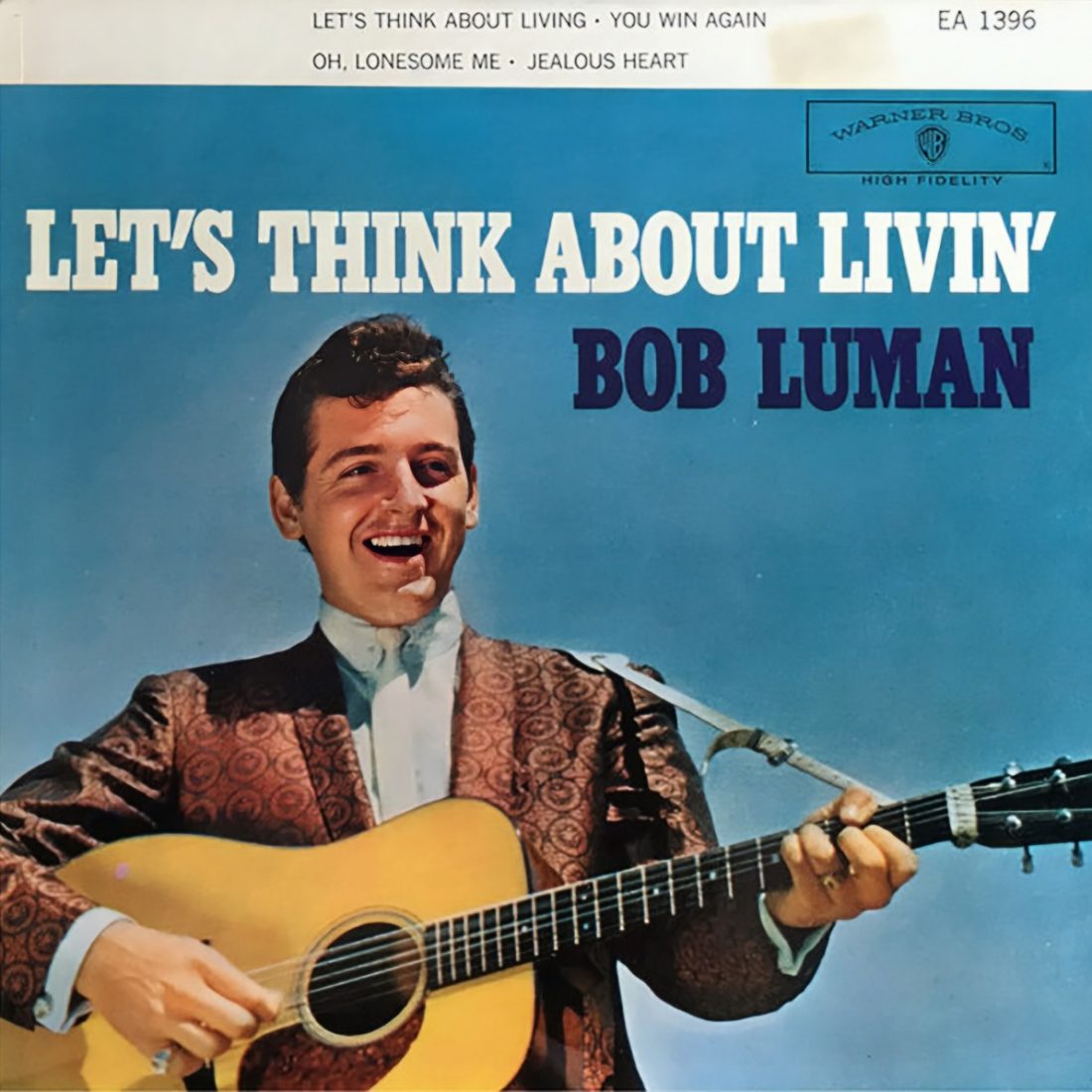
In 1960, after several persevering years, Luman had a smash hit with Let’s Think About Living, the song reaching No.7 on the Billboard Hot 100 and No.9 on the US country charts. The disc fared even better in Britain, reaching No.6 and spending 18 weeks on the pop chart. But Luman was earmarked for a spell in the US Army at the time and ill-placed to cash in on his suddenly elevated profile. He never had another significant pop hit, although Why, Why, Bye, Bye and The Great Snow Man bubbled under the Top 40 when subsequently released in the UK. So he settled down to being a middling kind of country singer and was solidly successful in this endeavour.
Joel Whitburn’s Top Country Singles shows that between 1964 and 1978 he placed 34 singles on the country charts. But only four of them made the Top 10.
Stranger Than Fiction
Born in 1937, like many a budding young Texan musician in the early 1950s, Luman had started out idolising Lefty Frizzell. But then in the Spring of 1955, Luman had his head turned when he saw Elvis Presley performing in Kilgore, the town where Bob had attended high school and formed his first country band. Though he’d never lose his country inflections, he became set on carving out a career in the mould of Presley.
Several unreleased demos recorded in Dallas around this time, now popular on the aforesaid rockabilly compilations, included In The Deep Dark Jungle and Stranger Than Fiction. The tracks resurfaced in the 70s on the Rollin’ Rock label (see boxout), and these crudely recorded but energetic takes were heard by proto-British rockabillies looking for alternative sources of material to the standards favoured by the older revival acts. One of The Polecats’ demos in their formative years included Luman’s Stranger Than Fiction.
Around the time Luman was recording his Dallas demos, Johnny Horton had taken over from Elvis Presley as the major attraction on the Louisiana Hayride, a few miles east of Kilgore and across the Texas border. When Luman won a talent contest where Horton happened to be a judge, it followed that an invite to appear on the show his hero had recently wowed would soon be on the way. There was, however, a complication in that Luman was also adept at baseball. An invitation to pursue training with the Pittsburgh Pirates had to be turned down, but Luman, with his looks and personality, clearly had the potential to be a musical star.
In 1957, having joined the Hayride the previous year after Johnny Cash departed, Luman made 20 straight appearances on the show.
It was on the Hayride that he met a stick thin young guitarist named James Burton, who’d become a staff musician on the show at the age of 14, and at around the same time was demoing his legendary riff with Dale Hawkins on what was to become the swamp rock classic Susie Q.
Along with bass player James Kirkland and drummer Butch White, Burton backed Luman in a band called The Shadows when he made his first singles for Lew Chudd’s Imperial Records. These included Red Hot, modelled more on the Billy Lee Riley version than the Billy ‘The Kid’ Emerson original, as well as the magnificent Red Cadillac And Black Mustache.
Straight Outta Compton
While the records didn’t sell, Luman and The Shadows felt confident enough to shift their base to Hollywood. They were shown to good effect in the Roger Corman-directed drive-in movie Carnival Rock (1957). In it they performed two songs, This Is The Night, which gave Burton the chance to solo, and the bluesier All Night Long. Luman also became a regular on Town Hall Party, broadcast live from Compton, California, and one of the most popular TV music shows of the time.
However, disaster lay round the corner when fellow Imperial artist Ricky Nelson caught sight of the act and poached The Shadows. Burton, of course, went on to become one of the most important rock’n’roll guitar players, but Luman’s connection with his old bandmates didn’t entirely sever, and when he returned to play the Hayride later on, Burton and Kirkland sometimes guested with him.
As his time with Imperial yielded poor sales, Luman moved on to a brief stint with Capitol Records. Try Me was R&B by the numbers, with irritating backing vocals, and the flipside, I Know My Baby Cares, confirmed the softening of his style. But then he tried his luck at Warners, with more promising results. Class Of ’59 was a reasonable attempt at the soft pop-rock style increasingly in vogue. Meanwhile, Dreamy Doll, paired with a decent rocker in Buttercup (which had the bonus of Roy Buchanan on guitar), was a solid move into the rockaballad territory.
But it just wasn’t happening for Luman sales-wise and by 1960, still only 23, he was preparing to quit the music business and revive his baseball ambitions.
That plan was cancelled, though, when The Everly Brothers told him about a song handed to them by their go-to writing team of Felix and Boudleaux Bryant, which they’d rejected as unsuited to their style. Bryant had whipped up the lyric of Let’s Think About Living as a tongue-in-cheek answer to the era’s mania for death ballads or tragedy songs. It included references to Marty Robbins’ gunfighter ballad El Paso, and the Everlys’ own Cathy’s Clown and was hooky enough for commercial take-off, but Luman was unable to replicate its success.
Opry-tunity Knocks
His country rebirth took off after he joined Hickory in 1964 and continued with Epic from the end of the 60s. He joined the Grand Ole Opry in 1965 but, with his edgy rock leanings periodically resurfacing, he never entirely fitted in at this essentially conservative institution. Country traditionalist and Opry grandee Roy Acuff once remarked that Luman seemed unable to decide whether he was a white or a Black singer.
Luman was friends with another fine Texas-born rockabilly Mac Curtis whose band had actually backed him on his early Dallas demos in 1955. But arguably his career bears more comparison with another contemporary, Warren Smith. Both had started out with the intention to be country singers but then switched to rockabilly with the rise of Elvis.
Unlike Luman, however, Smith was at heart a true country singer and possibly only reluctantly tried his hand at rockabilly when recording with Sun. He cut many sides that are now essential listening for rockabilly fans, among whom he is held in the highest regard. Smith even recorded a brilliant unreleased version of Luman’s best rockabilly track, Red Cadillac And Black Mustache, while on Sam Phillips’ label. Like Luman, though perhaps more willingly, Smith subsequently switched to country after departing Sun and scored a few hits with Liberty. He also went on to join the Grand Ole Opry.
Both he and Luman had a liking for the bottle, which might have hindered their career development, but Smith went over well when he came to Europe towards the end of the 70s during the rockabilly revival. When he performed at London’s Rainbow Theatre in 1977, on a bill which included Charlie Feathers, Buddy Knox, Jack Scott and Crazy Cavan & The Rhythm Rockers, it was Smith’s first live show in five years. A career renaissance, on this side of the Atlantic at least, looked a distinct possibility until he suddenly died of a heart attack in 1980 at the age of 47.
When Luman toured the UK in 1963 with Roy Orbison, he was somewhat overshadowed by a host of then hot British beat bands who were also on the bill, including The Searchers, Freddie & The Dreamers and Brian Poole & The Tremeloes. But he reckoned on a second coming when he had learnt of the 70s revival following the success of his old mate Mac Curtis. In interviews, Luman had always referred to himself as being a rockabilly at heart, and now he aimed to get a piece of the action.
Unfortunately, once again fate played its hand. In 1976, Luman was hospitalised and underwent surgery to repair a ruptured blood vessel in his oesophagus. Following his release, he returned to the studio to record his optimistically titled Alive And Well! LP with producer Johnny Cash. However, he sadly performed for the final time at the Grand Ole Opry on 15 December 1978 and passed away from pneumonia 12 days later at the age of 41.
Subscribe to Vintage Rock here