A “shy boy”, A “mama’s boy”, A boy so nervous that he would panic when his father dived into a swimming pool: The young Elvis Presley, according to family friends, did not look to be a confident star in the making. Michael Stephens charts the extraordinary transformation of Tupelo’s famous son…
Elvis Presley was more than a singer. He was – and still is – an icon of popular culture, the first larger-than-life superstar, a folk hero and legend, yet also something of a myth.
Decades after Elvis Presley’s death, his allure remains astonishing. Type ‘Elvis’ into Google and you get roughly 40,000,000 returns. By contrast, the UK’s biggest pop icon, ‘Lennon’, gets around half that number. Google is certainly not the arbiter of all, of course, but the search sends a message. Elvis is still all around.
It’s partly the myth that still fascinates, as the basics of Elvis Presley’s life read like a fable – his rags-to-riches life story featured family tragedy, a meteoric rise to fame, unrivalled adulation, an opulent lifestyle, excessive habits, and a tragic (and, some would argue, rather pathetic) demise.
But what a rise it was. And Elvis Aaron Presley’s influence on world pop culture began when he was just 10 years old.
Rags-To-Riches
The Presleys lived in Tupelo, Mississippi, and it was here that Elvis made his first public performance. Even at this tender age, Elvis would spend many Saturday afternoons at the Tupelo Courthouse from where the radio station WELO broadcast its Saturday Jamboree programme. The Presley family were not musical, but young Elvis was entranced by song. He sang Old Shep, a song about a 19-year-old German Shepherd dog, for WELO a few times.
Elvis had no formal training in music. In a 1965 interview he remembered, “I sang some with my folks in the Assembly Of God church choir [but] it was a small church, so you couldn’t sing too loud.”
But when, at the beginning of his school term in 1945, pupils were asked if they would like to read or sing a song at assembly, 10-year-old Elvis obliged. He sang Old Shep again. His teacher Oletta Grimes remembered, “He sang it so sweetly”. The school principal was similarly impressed and they decided Elvis should be entered into a singing competition in the upcoming 1945 Mississippi-Alabama Fair And Dairy Show, held in Tupelo.
Tupelo Talent
Legend has it that young Elvis, wearing glasses, had to stand on a chair to reach the microphone in front of several hundred people watching him perform at the fair (other attractions at the event included such items as mule-pulling contests). Elvis sang alone, and he didn’t win: some early records say he was second (myth again). As Presley himself later said “I think I was fifth”. But he did win free passes for all of the rides at the fair, plus $5. Plus, he also got to be broadcast on his beloved WELO Saturday Jamboree radio programme.
Five bucks was a lot of money to young Elvis. The Presley family were poor and constantly fretting about money. Meagre meals of cornbread and water were not uncommon – a sad situation which, some might suggest, shaped Elvis’s later addiction to lavish meals. But parents Gladys and Vernon Presley doted on Elvis as best they could, even if he wasn’t immune to a whipping for bad behaviour. However, their ultimate love was understandable: Elvis was the twin of a boy who was stillborn.
His parents saved enough money to offer him, for his 11th birthday of 8 January 1946, a choice of present – a bicycle or a guitar. Elvis wanted the bicycle, but mother Gladys was fearful he would get run over. She cajoled him: “Son, wouldn’t you rather have the guitar? It would help you with your singing, and everyone does enjoy hearing you sing.”
If ever a simple gift born of a mother’s worry has shaped pop culture, it was surely this: Elvis Presley was given a guitar for his 11th birthday. And soon after that, everything surrounding him changed, too – for when Elvis was 13, the Presley family relocated from Tupelo to Memphis.
Memphis Calling
Memphis would have been a musical Mecca for the young Elvis. Home city to numerous blues pioneers, the scene revolved around the legendary Beale Street, though Elvis, still young, had to mainly settle for the seductive sounds of Memphis radio. But the city was alive with culture, and Elvis and his new pals would occasionally venture to Beale and Main Streets to watch the street performers, or just hang out at the vibrant local markets where there was always music playing.
Memphis radio was aural nectar, and by 1950 Elvis could have been listening to southern blues hits by Muddy Waters, Lowell Fulson, Elmore James and many more. Elvis was still taking his guitar to his new Humes School, but he remained a reluctant performer. His father Vernon later remembered, “He got shy. He was afraid the kids would laugh at him.”
Once again, it’s a myth that Elvis Presley the schoolboy was practically useless at anything but music studies. His school grades were decent, if hardly spectacular. He got an A for Language and some Bs and Cs yet regular Excellent ratings for application, if not for aptitude. Ironically, one of his C grades was for music.
That grading stung Elvis. In perhaps a pivotal moment, he overcame his shyness and asked to play in front of class to prove wrong his music teacher Miss Marmann, who had said he “couldn’t sing”. According to schoolmate Katie Mae Shook, Marmann capitulated with a back-handed compliment: “She agreed that Elvis was right and she didn’t appreciate his kind of singing.” Nevertheless, Elvis had made his point to appreciative classmates. He eventually left High School with a Diploma, of which he was immensely proud all his life.
(He’s) Sexy + 17
As he matured around the time of his 17th birthday, Elvis began to set himself apart. Despite – or perhaps because of – his poor upbringing, he decided to dress differently. He wore ‘dress pants’ (suit trousers) while his classmates wore denim. He draped cheap yet extravagant scarves around his neck. He grew his sideburns like the cross-country truck drivers he admired so much. He put Vaseline in his hair to keep his proto-quiff in check. Elvis volunteered to play football, but was allegedly kicked off the team by other players when he refused to cut his hair. The teenage Elvis was blossoming into an early archetype of the rock’n’roll outsider.
Elvis didn’t now care about the occasional snide remarks of his schoolmates as music was now his best friend, albeit mostly in the gospel churches and concerts that he and his family regularly attended.
In April 1953, aged 18, and a couple of months before he graduated from high school, Elvis performed in Humes’ School annual Minstrel Show. He was 16th on a 22-act bill and listed in the programme as ‘Elvis Prestly’, but he wowed classmates, parents, and teachers alike with his performance of Teresa Brewer’s early 1952 hit Till I Waltz Again With You.
Elvis later noted, “It was amazing how popular I became after that.” The once-shy boy had managed to suddenly set aside his inner insecurities in favour of being an animated performer. This ‘odd-looking shy boy’, Elvis Presley the ‘mama’s boy’, suddenly found himself on the lips of all who knew him.
Solar Power
In Memphis, the influence of local Sun Records was inescapable, and the label’s output was regularly played on the radio stations that Elvis devoured. It was perhaps no surprise when, in August 1953, he walked into the offices of Sun.
Elvis aimed to pay for a few minutes of studio time to record a two-sided acetate disc: My Happiness and That’s When Your Heartaches Begin. Elvis later claimed he wanted the record as a gift for his mother, or was merely interested in what he ‘sounded like’ on record. But there was a much cheaper, amateur record-making service available at a nearby general store. So perhaps that’s another self-deprecating myth?
Elvis biographer Peter Guralnick believes that Elvis was simply being canny: he knew all about Sam Phillips and Memphis music from nights with his ear pressed close to the radio speaker. Elvis went to Sun in the hope of releasing a record. Here, the Elvis legend truly begins. Sun Studio receptionist Marion Keisker was told by Elvis, “I sing all kinds”, but when she pressed him on whom he really sounded like, he repeatedly answered, “I don’t sound like nobody”. Elvis charmed Keisker to the point where she later remembered: “He was so ingenious, there was no way he could go wrong.”
Sam Phillips himself was initially unconvinced, but after another two exploratory singing sessions he asked Elvis back to meet two local musicians he knew: guitarist Winfield ‘Scotty’ Moore and upright bass player Bill Black. Phillips wanted 19-year-old Elvis Presley to try a ‘proper’ recording session.
All Right On That Night
Elvis’s first official session of 5 July 1954 was nothing special until, late at night, Presley took his guitar and launched into a 1949 blues number, Arthur Crudup’s That’s All Right. Scotty Moore recalled, “All of a sudden, Elvis just started singing this song, jumping around and acting the fool, and then Bill picked up his bass, and he started acting the fool, too, and I started playing with them.
“Sam [Phillips], I think, had the door to the control booth open… he stuck his head out and said, ‘What are you doing?’ And we said, ‘We don’t know…’ ‘Well, back up,’ Sam said, ‘try to find a place to start, and do it again!’”
Phillips quickly began taping. If nothing else, the studio owner was amazed this 19-year-old white boy knew an Arthur Crudup song. Just three days later, popular Memphis DJ Dewey Phillips played the raw acetate of That’s All Right on his Red, Hot And Blue radio show. Phonecalls flooded in: who was this singer? Interviewing a nervous Presley live-on-air later, Dewey Phillips clarified Elvis’s colour by asking him to state the school that he had attended (schools in the South were still segregated at this point) for the benefit of listeners who might assume the singer was a black American.
Sam Phillips, says Marion Keisker, had a regular mantra at the time: “If I could find a white man who had the negro sound and the negro feel, I could make a billion dollars.”
The Myth, The Legend
Myth? Legend? It was a bit of both. But Phillips had now found a young white man who could pay that billion dollar cheque… even if Elvis Presley, in his more mundane life, was recently a truck driver for the Crown Electric Company earning just $1 an hour.
That’s All Right was no immediate smash. It sold 20,000 copies eventually and hit No 4 on the local Memphis charts. Nationally, it didn’t originally have much commercial impact. Part of the problem was that radio stations were reluctant to even play it – most stations, in fact, played the B-side, Blue Moon Of Kentucky, instead. But for those music fans looking out for something new, That’s All Right was like a lightning bolt.
As Elvis’ close friend George Klein remembered, “It was so different – a white guy singing a rhythm and blues song. It was the beginning. A lot of [DJ] guys were apprehensive to play it.”
Musicologists and writers have debated for decades what the first rock’n’roll record really was. It’s a futile pursuit, of course, as music always evolves gradually and there are no flags in the sand that define a ‘big bang’ of something 100 per cent new. The Sex Pistols weren’t the first ‘punks’, Gil Scott Heron and the Last Poets were ‘rapping’ before hip-hop became a named genre, Black Sabbath didn’t ‘invent’ so-called heavy metal, and so on.
Presley himself once remarked: “A lot of people seem to think I started this business, but rock’n’roll was here a long time before I came along.”
A New World Of Music
But Elvis certainly started something. While most scholars (or music nerds) claim Jackie Brenston’s Rocket 88 (recorded in 1951 by Ike Turner and his band at Sam Phillips’ Sun studios but credited solely to Brenston, the singer on the session) has the best claim to be the first true rock’n’roll single, Elvis’s That’s All Right blew down the walls. In 1954, America was still highly segregated. Few ordinary white people paid attention to ‘negro’ singers. But white boy Elvis, who many first assumed was black, opened the door to a whole new world of music.
Press reviewers didn’t even know how to describe Elvis. Early reviews of That’s All Right and Presley variously describe him as a “hillbilly singer”, “a young rural rhythm talent”, a “white man singing negro rhythms with a rural flavour”, and “a young man with a boppish approach to hillbilly music”. All just words, ultimately. But it was the music and Elvis’s image, not the words of the critics, that really resonated.
As John Lennon, a young Liverpudlian boy who only first heard Elvis on 1956’s Heartbreak Hotel, said: ‘Before Elvis, there was nothing.’ As soon as Lennon heard Elvis on the radio, he asked his family to buy him a guitar.
Shakin’ All Over
After releasing That’s All Right, Elvis was increasingly in demand as a live singer. An appearance in September 1954 at Memphis’ Katz drugstore – a showcase, in today’s terminology – drew a crowd of teenagers. The late country legend Johnny Cash was a witness to the event.
“The first time I saw Elvis, singing from a flatbed truck at a Katz drugstore opening on Lamar Avenue, two or three hundred people, mostly teenage girls, had come out to see him,” Cash remembered. “He sang those two songs [That’s All Right and Blue Moon Of Kentucky] over and over… plus some black blues songs and a few numbers like [Little Richard’s] Long Tall Sally, and he didn’t say much.”
Elvis didn’t need to say much; his leg gyrations did it for him. In a recently-recovered interview from 1956, Presley recalled: “I guess people want to know why I can’t sit still when I’m singing. Some people tap their feet, some people snap their fingers, and some people sway back and forth. I just sort of do them all together, I guess. I watch the audience and we are getting something out of our system and no-one knows what it is.” The adage of ‘all the girls want him, and all the boys want to be him’ had begun.
We Have Lift-Off
By the time of his second single, Good Rockin’ Tonight backed with I Don’t Care if The Sun Don’t Shine, Phillips had managed to secure Elvis an appearance at the Grand Ole Opry (October 1954). This was a breakthrough, as the Opry, a strictly-organised showcase of wholesome, family-friendly country entertainment, had never booked a singer so early in his career. Elvis’s performance of Blue Moon Of Kentucky received a “polite, but somewhat tepid, reception” said one press report, and the Opry’s manager later told Phillips that Presley “just did not fit the Opry mould”.
Elvis was crestfallen, but remained determined. In the first fortnight of October 1954, he played seven shows. He managed to impress the Louisiana Hayride – a live Saturday night country music radio show, carried by 190 stations in 13 states. They offered him a regular slot, and Elvis quit his truck-driving job.
Elvis had suddenly become a professional singer. More than that, his local shows were attracting so much attention, he soon found it hard to commit to the Hayride. Memphis: we have lift-off.
Pop Phenomenon
Elvis’ meteoric rise remains a true pop phenomenon. The Beatles toiled at home and abroad for quite a few years before breaking through; in more recent times, Oasis got very big very quickly, but of course their trajectory was aided by a highly-evolved modern music media offering endless press promotion, video and outlets for songs. In the context of mid-50s America, Elvis Presley’s ascendancy remains perhaps the most remarkable of any pop star.
On 5 January 1955, ‘Alvis Presley’ (as he was billed) topped the bill at Texas’s San Angelo City Auditorium. It seated 1,855, and hundreds of teenage girls rushed the stage for Elvis’ autograph. Three days later, he managed to sing for the Hayride again: Elvis was introduced as the ‘Memphis Flash’ and was described to the radio audience as wearing ‘crocodile-skin shoes with pink socks.’ Back then, he must have sounded like some alien dandy superhero. Before long, he was even wearing pink trousers and a charcoal tuxedo. Madness, you might think, but no-one thought Elvis was ‘weird’ anymore: the girls and boys understood – this man had the style, sex and rebellion that has since defined pop music.
Elvis soon had a new manager on board, the notorious ‘Colonel’ Tom Parker, who put Elvis on a support slot with singer Hank Snow. A cheque was made out to Elvis for $425 (which equates to $3,000-plus in today’s money) – and that was just a 50 per cent advance on what he could expect to earn over a period of just five days.
Rock’n’Roll Riot
At the end of a Jacksonville performance in May 1955, Elvis announced to the audience of 14,000: “Girls, I’ll see you backstage”. A full-scale riot then ensued, with fans chasing Elvis into his dressing room and tearing off his clothes and shoes. This was fully-fledged pop mania on a level that overshadowed even Frank Sinatra’s troupe of famously overzealous ‘bobby soxer’ fans. Tom Parker’s eyeballs must have been rotating with dollar signs.
Yet for a 21-year-old with the world soon to be at his feet, Presley was still full of the doubts and outsider mentality of his formative years. In 1956, he candidly admitted: “Maybe someday I’m going to have a home and a family of my own, and I’m not going to budge from it. I was an only child, but maybe my kids won’t be. Am I in love? No. I thought I’ve been in love, but I guess I wasn’t. It just passed over. I guess I haven’t met the girl yet, but I will and I hope it won’t be too long because I get lonesome sometimes.
“I get lonesome right in the middle of a crowd, and I get the feeling that with her, whomever she may be, I won’t be lonesome, no matter where I’ll be.”
Star Power
And Elvis, like many artists, remained a mass of contradictions. Even at 21, he was adored yet felt “lonely”. Scotty Moore remembered him as a “typical coddled son… he was more comfortable just sitting there with a guitar than trying to talk to you… there was nothing phony about it, he truly loved his mother.” Give him a stage, however, and Elvis was instantly transformed.
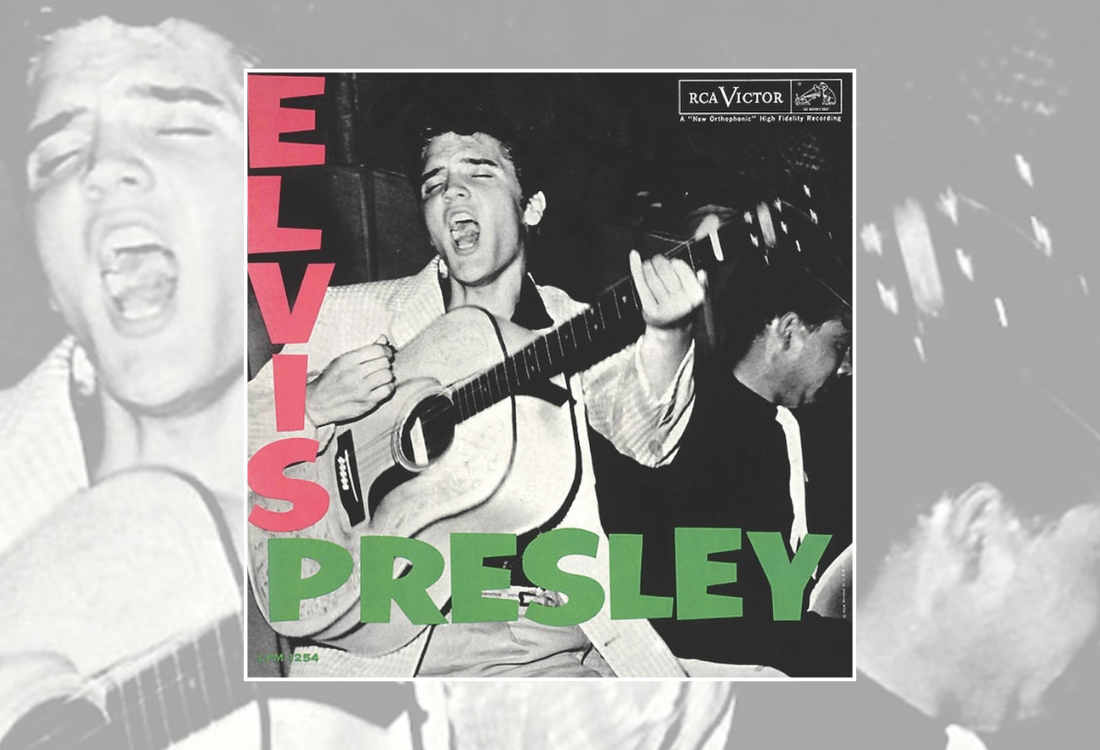
It was 1956 before Presley released his debut album and appeared on TV, but by the end of 1955 he was already a star. The world just didn’t know it.
Elvis Presley, the performer, was like no other of his time. He not only had the voice and the songs, he also had the moves. He could sex-up a crowd of girls (and boys), he dressed with a confident panache, and he had a winning smile. The once-shy boy, at 21, had become King.
For more Elvis visit the official site here
Subscribe to Vintage Rock here